
Inicio > Ciencias de la tierra, geografía, medioambiente, planificación > El medioambiente > Pensamiento e ideología ecologista > Review of the EPA’s Economic Analysis of Final Water Quality Standards for Nutrients for Lakes and Flowing Waters in Florida
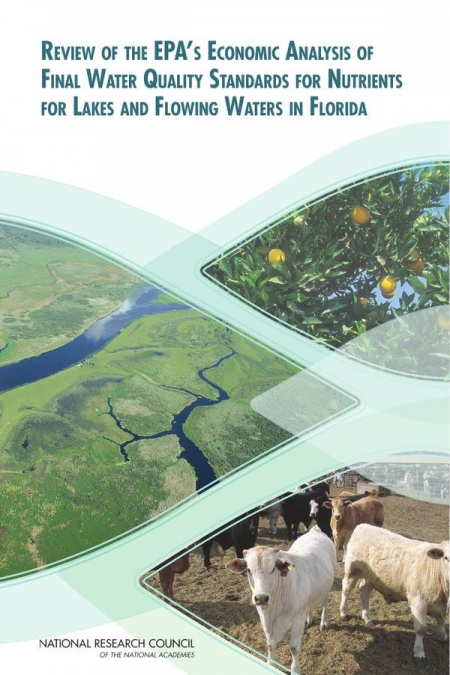
Review of the EPA’s Economic Analysis of Final Water Quality Standards for Nutrients for Lakes and Flowing Waters in Florida

Review of the EPA’s Economic Analysis of Final Water Quality Standards for Nutrients for Lakes and Flowing Waters in Florida

AA.VV

37,96 €
IVA incluido
Disponible
Editorial:
National Academies Press
Año de edición:
2012
Materia
Pensamiento e ideología ecologista
ISBN:
9780309254939
37,96 €
IVA incluido
Disponible

Selecciona una librería:

  • Librería Desdémona
  • Librería Samer Atenea
  • Librería Aciertas (Toledo)
  • Kálamo Books
  • Librería Perelló (Valencia)
  • Librería Elías (Asturias)
  • Donde los libros
  • Librería Kolima (Madrid)
  • Librería Proteo (Málaga)

The Environmental Protection Agency’s estimate of the costs associated with implementing numeric nutrient criteria in Florida’s waterways was significantly lower than many stakeholders expected. This discrepancy was due, in part, to the fact that the Environmental Protection Agency’s analysis considered only the incremental cost of reducing nutrients in waters it considered ’newly impaired’ as a result of the new criteria-not the total cost of improving water quality in Florida. The incremental approach is appropriate for this type of assessment, but the Environmental Protection Agency’s cost analysis would have been more accurate if it better described the differences between the new numeric criteria rule and the narrative rule it would replace, and how the differences affect the costs of implementing nutrient reductions over time, instead of at a fixed time point. Such an analysis would have more accurately described which pollutant sources, for example municipal wastewater treatment plants or agricultural operations, would bear the costs over time under the different rules and would have better illuminated the uncertainties in making such cost estimates.

Artículos relacionados

  • Teología verde
    Trees van Montfoort / Trees van Montfoort
    ’Teología verde’ presenta una significativa reconsideración teológica cristiana acerca de la relación entre Dios, la creación, la naturaleza y los seres humanos. Trees van Montfoort demuestra que la ecoteología no es una subdisciplina teológica, sino más bien un redescubrimiento de la teología centrada no sólo en Dios y las personas, sino en toda la creación. Éste es un libro p...
    Disponible

    23,40 €

  • Models in Environmental Regulatory Decision Making
    Many regulations issued by the U.S. Environmental Protection Agency (EPA) are based on the results of computer models. Models help EPA explain environmental phenomena in settings where direct observations are limited or unavailable, and anticipate the effects of agency policies on the environment, human health and the economy. Given the critical role played by models, the EPA a...
    Disponible

    58,76 €

  • Public Participation in Environmental Assessment and Decision Making
    Federal agencies have taken steps to include the public in a wide range of environmental decisions. Although some form of public participation is often required by law, agencies usually have broad discretion about the extent of that involvement. Approaches vary widely, from holding public information-gathering meetings to forming advisory groups to actively including citizens i...
    Disponible

    72,28 €

  • Assessing Economic Impacts of Greenhouse Gas Mitigation
    Many economic models exist to estimate the cost and effectiveness of different policies for reducing greenhouse gas (GHG) emissions. Some approaches incorporate rich technological detail, others emphasize the aggregate behavior of the economy and energy system, and some focus on impacts for specific sectors. Understandably, different approaches may be better positioned to provi...
    Disponible

    26,52 €

  • Environmental Decisions in the Face of Uncertainty
    The U.S. Environmental Protection Agency (EPA) is one of several federal agencies responsible for protecting Americans against significant risks to human health and the environment. As part of that mission, EPA estimates the nature, magnitude, and likelihood of risks to human health and the environment; identifies the potential regulatory actions that will mitigate those risks ...
    Disponible

    46,28 €

  • Modeling the Economics of Greenhouse Gas Mitigation
    Models are fundamental for estimating the possible costs and effectiveness of different policies for reducing greenhouse gas (GHG) emissions. There is a wide array of models to perform such analysis, differing in the level of technological detail, treatment of technological progress, spatial and sector details, and representation of the interaction of the energy sector to the o...
    Disponible

    42,59 €