
Inicio > Ciencias de la tierra, geografía, medioambiente, planificación > El medioambiente > Pensamiento e ideología ecologista > Rethinking the Components, Coordination, and Management of the U.S. Environmental Protection Agency Laboratories
Rethinking the Components, Coordination, and Management of the U.S. Environmental Protection Agency Laboratories

Rethinking the Components, Coordination, and Management of the U.S. Environmental Protection Agency Laboratories

AA.VV

43,63 €
IVA incluido
Disponible
Editorial:
National Academies Press
Año de edición:
2014
Materia
Pensamiento e ideología ecologista
ISBN:
9780309312370
43,63 €
IVA incluido
Disponible

Selecciona una librería:

  • Librería Samer Atenea
  • Librería Aciertas (Toledo)
  • Kálamo Books
  • Librería Perelló (Valencia)
  • Librería Elías (Asturias)
  • Donde los libros
  • Librería Kolima (Madrid)
  • Librería Proteo (Málaga)

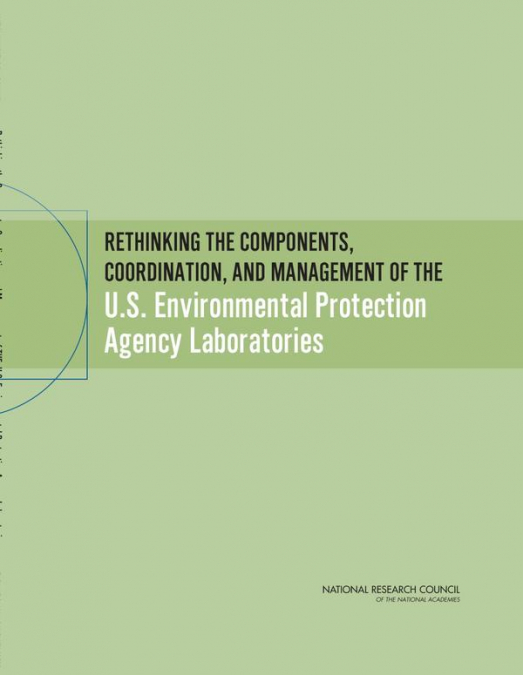
The Environmental Protection Agency (EPA) applies scientific results that have been provided by various parts of its own organization and by external organizations. The agency requires substantial high-quality inhouse scientific expertise and laboratory capabilities so that it can answer questions related to regulation, enforcement, and environmental effects of specific chemicals, activities, and processes. It is also usually faced with situations in which research or analytic work is time-critical, so it maintains dedicated laboratory staff and facilities that can respond quickly to such needs. In recent years, EPA has made several changes to improve the efficiency and effectiveness of its laboratories, such as the designation of national program directors to align the work of research laboratories with the needs of the agency’s regulatory program offices. The agency is currently undertaking an integrated evaluation of it laboratories to enhance the management effectiveness and efficiency of its laboratory enterprise and to enhance its capabilities for research and other laboratory-based scientific and technical activities. The results of EPA’s evaluation are expected to include options for colocation and consolidation of laboratory facilities. Rethinking the Components, Coordination, and Management of U.S. Environmental Protection Agency Laboratories assesses EPA’s highest-priority needs for mission-relevant laboratory science and technical support, develops principles for the efficient and effective management of EPA’s laboratory enterprise to meet the agency’s mission needs and strategic goals, and develops guidance for enhancing efficiency and effectiveness now and during the next 10 years. EPA’s laboratories play a vital role in the agency’s work. The findings and recommendations of this report will help EPA to develop an implementation plan for the laboratory enterprise.

Artículos relacionados

  • Teología verde
    Trees van Montfoort / Trees van Montfoort
    ’Teología verde’ presenta una significativa reconsideración teológica cristiana acerca de la relación entre Dios, la creación, la naturaleza y los seres humanos. Trees van Montfoort demuestra que la ecoteología no es una subdisciplina teológica, sino más bien un redescubrimiento de la teología centrada no sólo en Dios y las personas, sino en toda la creación. Éste es un libro p...
    Disponible

    23,40 €

  • Models in Environmental Regulatory Decision Making
    Many regulations issued by the U.S. Environmental Protection Agency (EPA) are based on the results of computer models. Models help EPA explain environmental phenomena in settings where direct observations are limited or unavailable, and anticipate the effects of agency policies on the environment, human health and the economy. Given the critical role played by models, the EPA a...
    Disponible

    58,76 €

  • Public Participation in Environmental Assessment and Decision Making
    Federal agencies have taken steps to include the public in a wide range of environmental decisions. Although some form of public participation is often required by law, agencies usually have broad discretion about the extent of that involvement. Approaches vary widely, from holding public information-gathering meetings to forming advisory groups to actively including citizens i...
    Disponible

    72,28 €

  • Assessing Economic Impacts of Greenhouse Gas Mitigation
    Many economic models exist to estimate the cost and effectiveness of different policies for reducing greenhouse gas (GHG) emissions. Some approaches incorporate rich technological detail, others emphasize the aggregate behavior of the economy and energy system, and some focus on impacts for specific sectors. Understandably, different approaches may be better positioned to provi...
    Disponible

    26,52 €

  • Environmental Decisions in the Face of Uncertainty
    The U.S. Environmental Protection Agency (EPA) is one of several federal agencies responsible for protecting Americans against significant risks to human health and the environment. As part of that mission, EPA estimates the nature, magnitude, and likelihood of risks to human health and the environment; identifies the potential regulatory actions that will mitigate those risks ...
    Disponible

    46,28 €

  • Modeling the Economics of Greenhouse Gas Mitigation
    Models are fundamental for estimating the possible costs and effectiveness of different policies for reducing greenhouse gas (GHG) emissions. There is a wide array of models to perform such analysis, differing in the level of technological detail, treatment of technological progress, spatial and sector details, and representation of the interaction of the energy sector to the o...
    Disponible

    42,59 €