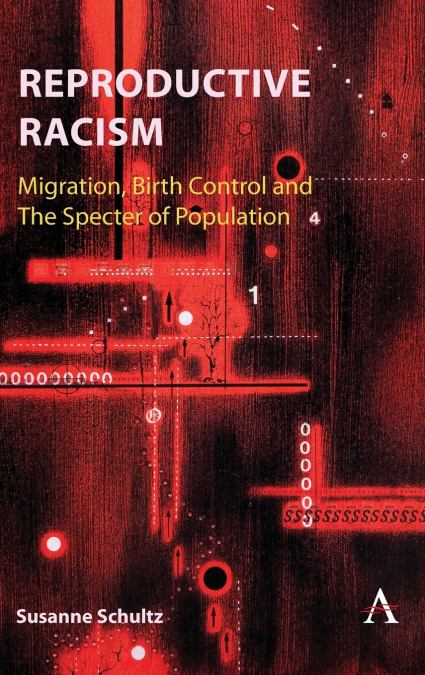

Reproductive Racism

Reproductive Racism

Susanne Schultz

158,40 €
IVA incluido
Consulta disponibilidad
Editorial:
Wimbledon Publishing
Año de edición:
2023
Materia
Cuestiones éticas: aborto y control de la natalidad
ISBN:
9781839985874

Selecciona una librería:

  • Librería Samer Atenea
  • Librería Aciertas (Toledo)
  • Kálamo Books
  • Librería Perelló (Valencia)
  • Librería Elías (Asturias)
  • Donde los libros
  • Librería Kolima (Madrid)
  • Librería Proteo (Málaga)

Population is a dangerous political category. It is not separable from the racist and class-based valorisation and devaluation of different lives. From global contraceptive implant programmes to right wing anti-immigration discourses, demographic interpretations of multiple current crises legitimise the states’ grip on childbearing and mobility. The results are complex dimensions of reproductive racism and restrictive border regimes. Meanwhile, global social inequalities and racial capitalist extractivism stay out of the game. The book analyses how demographic knowledge production and states’ grip to the variable of population intertwine. It introduces the concept of the Malthusian matrix in order to understand how class-selective and racist hierarchies within population narratives are combined with gendered policies of reproductive bodies and behaviours. Several chapters explore current reproductive racism, establishing a hierarchy between the birth of desirable and undesirable people. An upward redistributive family policy in Germany is promoting births within the privileged middle classes. And international population programs revive targets in order to increase the use of long-acting contraceptives in the Global South, within a market-oriented setting of Big Pharma promotion. Reproductive racism is also effective in migration policy strategies: narratives about 'migrant birth rates' circulate among ultra-right forces as well as seemingly apolitical demographic policy consultancy. The last sections discuss state-theoretical approaches and the intersectional feminist concept of reproductive justice in order to provide tools for critique and resistance.

Artículos relacionados

  • Birth controlled
    Amrita Pande
    This book analyses the world of selective reproduction by a critical analysis of three modes of controlling birth, namely contraception, reproductive violence, and repro-genetic technologies. All population control policies target and vilify women (Black women in particular), and coerce them into subjecting their bodies to state and medical surveillance; Birth controlled argues...
    Disponible

    43,62 €

  • Sacred Rights
    Daniel C. Maguire
    ...
    Disponible

    71,76 €

  • How Ethical Systems Change
    Elyshia Aseltine / Sheldon Ekland-Olson
    Roe v. Wade came like a bolt from the blue, but support had been building for years. For many, the idea that life in the womb was not fully protected under the Constitution was simply not acceptable. Political campaigns were organized and protests launched, including the bombing of clinics and the killing of abortion providers. Questions about the protection and support of life...
    Disponible

    70,94 €

  • Abortion and the Private Practice of Medicine
    Jonathan B. Imber
    Originally published in 1986, Abortion and the Private Practice of Medicine was the first book to look at abortion from the perspective of physicians in private practice. Jonathan B. ...
    Disponible

    89,71 €

  • Anthropology of Pregnancy Loss
    Rosanne Cecil
    Contemporary, historical and oral-history accounts from regions as diverse as rural North India, urban America, South Africa and Northern Ireland, provide a fascinating insight into the experience and management of miscarriage across a number of different cultures. ...
    Disponible

    73,29 €

  • Birth Control and Controlling Birth
    Betty B. Hoskins / Helen B. Holmes / Michael Gross
    Women most fully experience the consequences of human reproductive technologies. Men who convene to evaluate such technologies discuss Itthem ': the women who must accept, avoid, or even resist these technologies; the women who consume technologies they did not devise; the women who are the objects of policies made by of women is neither sought nor li...