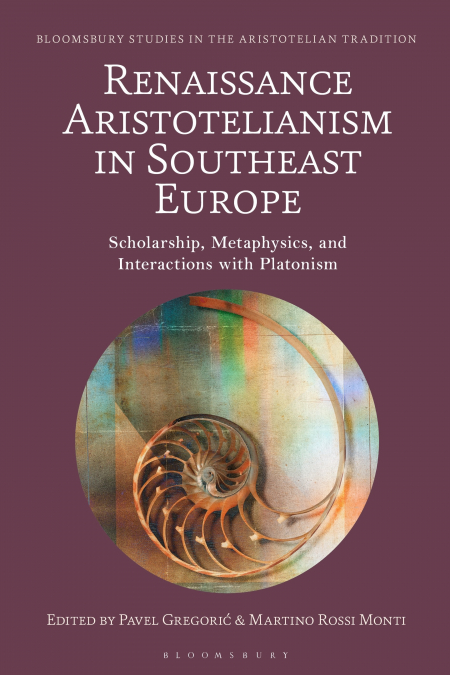

Renaissance Aristotelianism in Southeast Europe

Renaissance Aristotelianism in Southeast Europe


147,63 €
IVA incluido
Consulta disponibilidad
Editorial:
Bloomsbury Publishing plc
Año de edición:
2025
Materia
Filosofía occidental: antigua, hasta c. 500
ISBN:
9781350426597

Selecciona una librería:

  • Librería Samer Atenea
  • Librería Aciertas (Toledo)
  • Kálamo Books
  • Librería Perelló (Valencia)
  • Librería Elías (Asturias)
  • Donde los libros
  • Librería Kolima (Madrid)
  • Librería Proteo (Málaga)

In this volume, leading scholars explore aspects of Renaissance Aristotelianism in the overlooked region of Southeast Europe.Uncovering forgotten texts, neglected topics, and little-known authors, ten chapters examine the philosophies and scholarly practices of figures including Antonio Zara, Nikola Vitov Gucetic (Nicolaus Viti Gozzius), Matija Frkic (Matthaeus Ferchius), Juraj Dubrovcanin (Georgius Raguseius), and Daniel Furlanus.The volume is organized into three sections. ’Scholarship’ explores various aspects of accumulation, organization, and the display of knowledge typical for the Renaissance period. ’Metaphysics’ looks at Aristotelian cosmological theories and doctrines, as well as exceptions to the general demise of metaphysics as a discipline in the Renaissance. ’Interactions with Platonism’ provides different angles on how Renaissance philosophers handled the authority and the intellectual legacy of the two towering figures, Plato and Aristotle. In so doing, this volume provides insight into a number of topics central to Renaissance Aristotelianism in general.Beginning with an Editors’ Introduction offering vital context to the differing interpretations of Aristotelianism at the time, as well as a brief history of the areas in focus, this is an essential resource for anyone wanting to broaden their understanding of Renaissance Aristotelianism beyond the oft-examined cultural centres of Western Europe.


Artículos relacionados

  • The Nature of Things
    Lucretius Lucretius
    De rerum natura (On the Nature of Things) is a 1st century BC didactic poem by the Roman poet and philosopher Lucretius with the goal of explaining Epicurean philosophy to a Roman audience. Lucretius presents the principles of atomism; the nature of the mind and soul; explanations of sensation and thought; the development of the world and its phenomena; and explains a variety o...
  • Pompeii
    Fergus Mason
    Pompeii was one of most advanced cities of its time; it had a complex water system, gymnasium, and an amphitheater. Despite it's advancements, there was one thing it wasn't ready for: Mount Vesuvius—the volcano that led to its ultimate doom.  The 79 AD eruption of Mount Vesuvius was one of the worst disasters in all of European history. In a near instant, over 15,000 p...
    Disponible

    10,36 €

  • Middle Platonism and Neoplatonism, Volume 1
    Stephen Gersh
    'It is generally agreed that those types of philosophy that are loosely called ’Platonic’ and ’Neoplatonic’ played a crucial role in the history of European culture during the centuries between antiquity and the Renaissance. However, until now no scholar has attempted to describe the evolution of these forms of thought in a single comprehensive academic study.' So writes Stephe...
  • Middle Platonism and Neoplatonism, Volume 2
    Stephen Gersh
    It is generally agreed that those types of philosophy that are loosely called 'Platonic' and 'Neoplatonic' played a crucial role in the history of European culture during the centuries between antiquity and the Middle Ages. However, until now no scholar has attempted to describe the evolution of these forms of thought in a single comprehensive academic study. Middle Platonism a...
  • Porphyry’s Commentary on Ptolemy’s Harmonics
    Andrew Barker
    ...
    Disponible

    77,17 €

  • The Roots of Platonism
    John Dillon
    ...
    Disponible

    25,29 €