William Thomas Eckley / Corinne Buford Eckley
 Librería Samer Atenea
 Kálamo Books
 Librería Elías (Asturias)
 Librería Kolima (Madrid)
 Librería Proteo (Málaga)
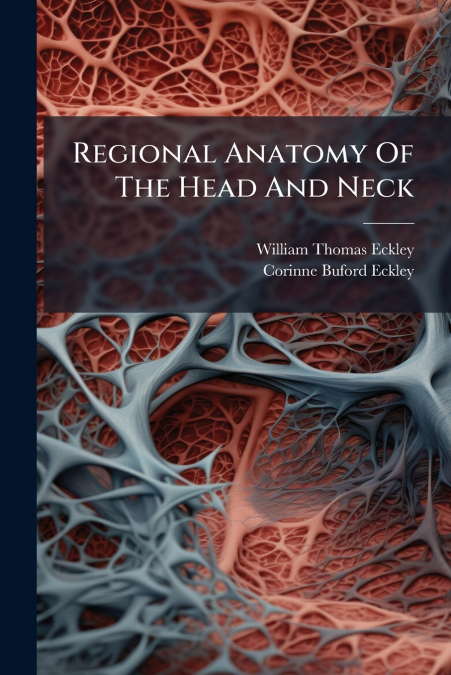
'Regional Anatomy Of The Head And Neck: For Students And Practitioners Of Dentistry' offers a detailed exploration of the anatomical structures within the head and neck region, specifically tailored for dental students and practitioners. Authored by William Thomas Eckley and Corinne Buford Eckley, this book provides a comprehensive understanding of the complex anatomy essential for dental procedures and diagnoses. The text delves into the regional approach to anatomy, allowing readers to grasp the spatial relationships and functional significance of various structures. With clear descriptions and illustrations, this book serves as an invaluable resource for anyone seeking to enhance their knowledge and skills in the field of dentistry. It’s a crucial guide for mastering the intricacies of head and neck anatomy, improving clinical practice and patient outcomes.This work has been selected by scholars as being culturally important, and is part of the knowledge base of civilization as we know it. This work was reproduced from the original artifact, and remains as true to the original work as possible. Therefore, you will see the original copyright references, library stamps (as most of these works have been housed in our most important libraries around the world), and other notations in the work.This work is in the public domain in the United States of America, and possibly other nations. Within the United States, you may freely copy and distribute this work, as no entity (individual or corporate) has a copyright on the body of the work.As a reproduction of a historical artifact, this work may contain missing or blurred pages, poor pictures, errant marks, etc. Scholars believe, and we concur, that this work is important enough to be preserved, reproduced, and made generally available to the public. We appreciate your support of the preservation process, and thank you for being an important part of keeping this knowledge alive and relevant.