 Librería Samer Atenea
 Kálamo Books
 Librería Elías (Asturias)
 Librería Kolima (Madrid)
 Librería Proteo (Málaga)
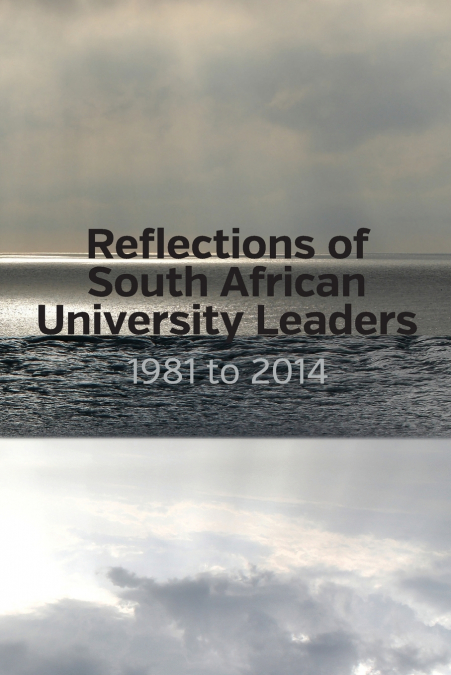
Much has been written about the ever-growing demands on university leadership worldwide in the face of increasingly complex changes and challenges from within the academy and beyond. However, as we are reminded by Johan Muller in the Introduction to this book, 'there are particular features of time and place that also throw up unique problems'. It is precisely ’time and place’ that make this set of reflections by university leaders quite remarkable and distinguishes it from the many biographies to be found in the literature on higher education leadership. ... In the main, this collection spans two decades, the 1990s and 2000s, of unprecedented levels of change in South African higher education. Leaders in universities, as well as those responsible for higher education policy in the government and associated statutory bodies, had no neat script to work off, nor ’manuals’ or prescripts of ’good’ leadership or practice. Instead, there was palpable excitement about collectively imagining and nurturing a new post-apartheid higher education system, which would contribute to the social and economic development needs of the country, the deepening of democracy and which would also be globally relevant. Most reflections touch on the coalface of leadership, which is the face-to-face interactional dimension, dealing with staff, with students, with council chairs. What comes through clearly, is the importance of what are sometimes called ’people skills’. In these accounts this is not simply presented as a human relations aptitude, for a number of reasons, first of which is the special nature of universities and their occupants. More than one points out the special challenge of managing the talented people that are academics, and their inbuilt distaste for bureaucracy, their reluctance to be managed or told what to do. The message here is consistently one of needing to be completely open with academics, the importance of maintaining the distinction between ’collegial’ and ’executive’ management (avoiding ’managerialism’), and the critical importance of winning and holding their trust. The inspiration for this collection arose in late 2013 in the Council on Higher Education’s (CHE) Monitoring and Evaluation Directorate, the directorate responsible for conducting research on the higher education landscape and monitoring the state of the sector. They noted that conditions besetting universities had grown increasingly complex, both globally but more especially locally, and the question arose - how had this altered the challenges to university leadership over the period between the new political dispensation and the second decade of the new millennium? More particularly, how had leaders with a proven track record of visionary and strong leadership during this period faced these challenges? How did they see the main changes that needed dealing with? What challenges did these changes pose and how were they successfully overcome? What did they think, looking back, were the main constituents of successful leadership and management? What wisdom could be distilled for posterity? The Directorate decided to invite a range of vice-chancellors and senior academic leaders who had completed their terms of office to contribute to a project that set out to gather such reflections and compile them into a publication.