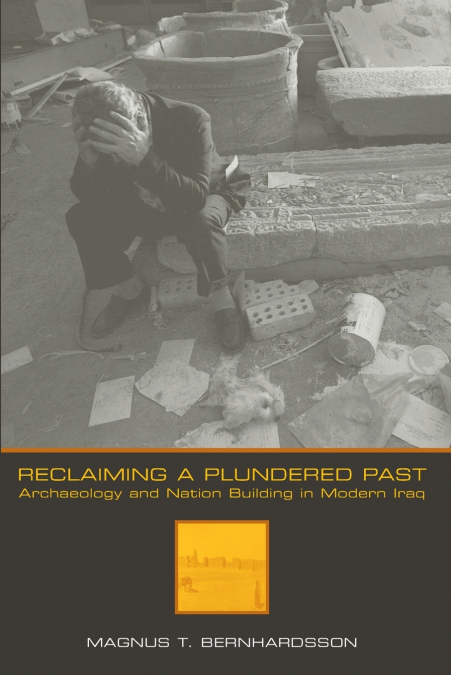
Reclaiming a Plundered Past

Reclaiming a Plundered Past

Magnus T. Bernhardsson / Magnus TBernhardsson

46,99 €
IVA incluido
Disponible
Editorial:
Univ of Chicago behalf of University of Texas
Año de edición:
2006
Materia
Sociedad y cultura: general
ISBN:
9780292725959
46,99 €
IVA incluido
Disponible

Selecciona una librería:

  • Librería Samer Atenea
  • Librería Aciertas (Toledo)
  • Kálamo Books
  • Librería Perelló (Valencia)
  • Librería Elías (Asturias)
  • Donde los libros
  • Librería Kolima (Madrid)
  • Librería Proteo (Málaga)

The looting of the Iraqi National Museum in April of 2003 provoked a world outcry at the loss of artifacts regarded as part of humanity’s shared cultural patrimony. But though the losses were unprecedented in scale, the museum looting was hardly the first time that Iraqi heirlooms had been plundered or put to political uses. From the beginning of archaeology as a modern science in the nineteenth century, Europeans excavated and appropriated Iraqi antiquities as relics of the birth of Western civilization. Since Iraq was created in 1921, the modern state has used archaeology to forge a connection to the ancient civilizations of Mesopotamia and/or Islamic empires and so build a sense of nationhood among Iraqis of differing religious traditions and ethnicities. This book delves into the ways that archaeology and politics intertwined in Iraq during the British Mandate and the first years of nationhood before World War II. Magnus Bernhardsson begins with the work of British archaeologists who conducted extensive excavations in Iraq and sent their finds to the museums of Europe. He then traces how Iraqis’ growing sense of nationhood led them to confront the British over antiquities law and the division of archaeological finds between Iraq and foreign excavators. He shows how Iraq’s control over its archaeological patrimony was directly tied to the balance of political power and how it increased as power shifted to the Iraqi government. Finally he examines how Iraqi leaders, including Saddam Hussein, have used archaeology and history to legitimize the state and its political actions.

Artículos relacionados

  • The Gandhian Iceberg
    Chris D Moore-Backman
    The Gandhian Iceberg presents a bold, new interpretation of Gandhian nonviolence from the rare perspective of an author who is equal parts writer, scholar, and frontlines practitioner. The book faces the current crisis of climate change and the intensification of social unrest around the world, and calls for a new convergence of serious, spiritually-rooted US nonviolence activi...
    Disponible

    11,52 €

  • Contemporary Developments in Child Protection
    Nigel Parton
    Volume 1 "Policy Changes and Challenges" takes as its central theme the ongoing and challenging issues which child protection agencies have to address and the policy and practice initiatives that are developed to try and address these. The volume includes papers on: the relationship between the decline in the rate of ‘unnatural’ deaths and the growth of concern about child abus...
  • Diversity in Information Technology Education
    Goran Trajkovski
    ...
  • Model-Driven Software Development
    Model-driven software development (MDSD) drastically alters the software development process, characterized by a high degree of innovation and productivity. However, quality assurance application in the domain of software models and model-driven software development is still in an emergent phase. Model-Driven Software Development: Integrating Quality Assurance provides in-depth...
  • Evidence-Based Practice in Nursing Informatics
    Andrew Chasin
    Because of the constant advances and dynamics within the nascent field of nursing informatics, many nurses struggle in practice as they continue to try and apply habitual communication practices in the new environment without any critical reflection on, and adaptation of, those practices. Evidence-Based Practice in Nursing Informatics: Concepts and Applications serves as a valu...
  • Actor-Network Theory and Technology Innovation
    Arthur Tatnall
    About 25 years ago, the first developments of ANT (Actor-Network Theory) took place, but it wasn’t until much later that researchers began to take it seriously. In the late 1990s, ANT began to take hold in the scientific community as a new and exciting approach to socio-technical research and social theory. Actor-Network Theory and Technology Innovation: Advancements and New Co...