 Librería Samer Atenea
 Kálamo Books
 Librería Elías (Asturias)
 Librería Kolima (Madrid)
 Librería Proteo (Málaga)
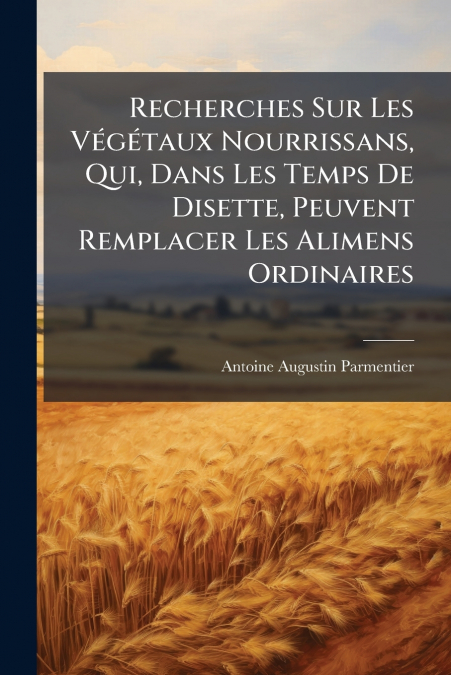
'Recherches Sur Les Végétaux Nourrissans, Qui, Dans Les Temps De Disette, Peuvent Remplacer Les Alimens Ordinaires' by Antoine Augustin Parmentier delves into the crucial topic of alternative food sources during times of scarcity. This historical work, subtitled 'Avec De Nouvelles Observations Sur la Culture Des Pommes De Terre...', reflects the author’s dedication to identifying and promoting plants that could serve as substitutes for common foods during famines. Parmentier’s research provides valuable insights into the agricultural and botanical knowledge of the period, with a specific focus on the cultivation of potatoes. This book offers a glimpse into the strategies and solutions devised to combat food shortages and improve public nutrition in France. Its enduring value lies in its exploration of innovative approaches to food security and its contribution to the understanding of plant-based nutrition.This work has been selected by scholars as being culturally important, and is part of the knowledge base of civilization as we know it. This work was reproduced from the original artifact, and remains as true to the original work as possible. Therefore, you will see the original copyright references, library stamps (as most of these works have been housed in our most important libraries around the world), and other notations in the work.This work is in the public domain in the United States of America, and possibly other nations. Within the United States, you may freely copy and distribute this work, as no entity (individual or corporate) has a copyright on the body of the work.As a reproduction of a historical artifact, this work may contain missing or blurred pages, poor pictures, errant marks, etc. Scholars believe, and we concur, that this work is important enough to be preserved, reproduced, and made generally available to the public. We appreciate your support of the preservation process, and thank you for being an important part of keeping this knowledge alive and relevant.