 Librería Samer Atenea
 Kálamo Books
 Librería Elías (Asturias)
 Librería Kolima (Madrid)
 Librería Proteo (Málaga)
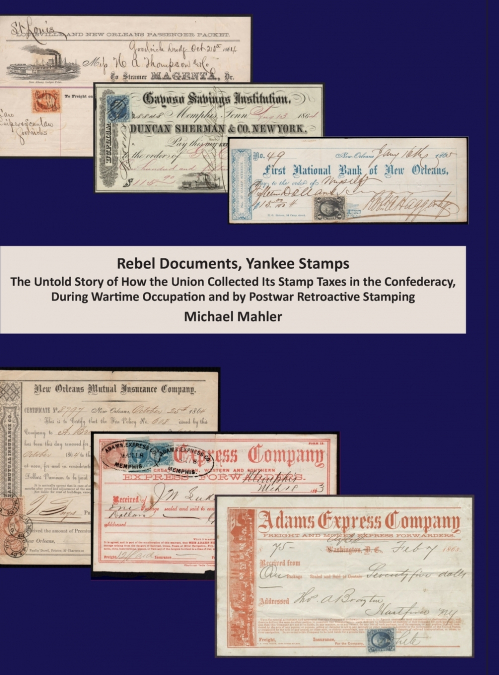
Here is one of the great stories of United States Civil War philately, explaining and illustrating, via revenue-stamped documents, the means by which the U.S. government collected its wartime documentary stamp taxes from the Confederacy.As part of a broad tax program designed to offset the rising costs of the Union Civil War effort, the U.S. Congress enacted a detailed schedule of documentary taxes, to take effect October 1, 1862. In the view of the Union government, the Confederacy consisted simply of eleven rebellious states, in which federal taxes were due and payable. Its collection of stamp taxes there occurred in two stages. First directly, in Union-occupied areas, primarily within U.S. Internal Revenue collection districts established in 1862-3 in Virginia, Tennessee and Louisiana; but also in Mississippi, Georgia, Arkansas and North Carolina. After cessation of hostilities, wartime documents executed within the former Confederacy, in areas never occupied or in which revenue stamps were not available, were required to be stamped retroactively. In practice this applied only to documents still in effect, such as promissory notes, deeds, mortgages, bonds and the like. This often required conversion from Confederate currency to that of the U.S. to ascertain the proper tax. This material is exceedingly rare; until now it has been virtually unrecognized by philatelists.