
Re-Orienting Fashion

Re-Orienting Fashion


206,33 €
IVA incluido
Consulta disponibilidad
Editorial:
Bloomsbury Publishing plc
Año de edición:
2003
Materia
Sociedad y cultura: general
ISBN:
9781859735343

Selecciona una librería:

  • Librería Samer Atenea
  • Librería Aciertas (Toledo)
  • Kálamo Books
  • Librería Perelló (Valencia)
  • Librería Elías (Asturias)
  • Donde los libros
  • Librería Kolima (Madrid)
  • Librería Proteo (Málaga)

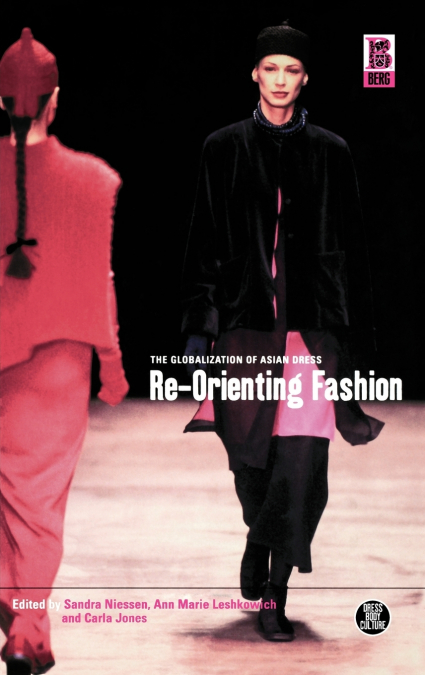
When Hong Kong entrepreneur David Tang opened his Shanghai Tang boutique on New York’s Madison Avenue, it was not an isolated example of the globalization of Asian fashion. Further evidence is written on the labels in our closets, and paraded in the form of salwaar-kameez and silk sarongs by the rich and famous of London. The phenomenon merits scrutiny. This vanguard attempt points to the colonial era as the origin of fashion globalization, and describes its development as paralleling the gradual take-over of Asian daily wear by Western dress. From indigenous Batak weavers to Hong Kong designers, and from Indonesian businesswomen’s power suits to Korean feminists’ national costume, this book explores the sartorial interface of East and West.The globalization of Asian dress needs to be understood as part of an ongoing Orientalism that construes Asia as a feminine Other to the masculine West. The conventional Orientalist definition of fashion as an exclusively Western phenomenon has proved self-fulfilling in both East and West so that the conceptual boundary between the two is continually reasserted by design. Paying close attention to Asians’ decisions about what clothing to make, sell, buy, and wear, the case studies in this book challenge Orientalist stereotypes of Asian style as passive and traditional and highlight how these actions are often made invisible by global cultural, rhetorical, and material practices that feminize Asia and the fashion world. This timely book will be of interest to dress and fashion theorists,anthropologists, sociologists, historians, art historians and all those interested in globalization, Orientalism and their effects.


Artículos relacionados

  • The Gandhian Iceberg
    Chris D Moore-Backman
    The Gandhian Iceberg presents a bold, new interpretation of Gandhian nonviolence from the rare perspective of an author who is equal parts writer, scholar, and frontlines practitioner. The book faces the current crisis of climate change and the intensification of social unrest around the world, and calls for a new convergence of serious, spiritually-rooted US nonviolence activi...
    Disponible

    11,52 €

  • Contemporary Developments in Child Protection
    Nigel Parton
    Volume 1 "Policy Changes and Challenges" takes as its central theme the ongoing and challenging issues which child protection agencies have to address and the policy and practice initiatives that are developed to try and address these. The volume includes papers on: the relationship between the decline in the rate of ‘unnatural’ deaths and the growth of concern about child abus...
  • Diversity in Information Technology Education
    Goran Trajkovski
    ...
  • Model-Driven Software Development
    Model-driven software development (MDSD) drastically alters the software development process, characterized by a high degree of innovation and productivity. However, quality assurance application in the domain of software models and model-driven software development is still in an emergent phase. Model-Driven Software Development: Integrating Quality Assurance provides in-depth...
  • Evidence-Based Practice in Nursing Informatics
    Andrew Chasin
    Because of the constant advances and dynamics within the nascent field of nursing informatics, many nurses struggle in practice as they continue to try and apply habitual communication practices in the new environment without any critical reflection on, and adaptation of, those practices. Evidence-Based Practice in Nursing Informatics: Concepts and Applications serves as a valu...
  • Actor-Network Theory and Technology Innovation
    Arthur Tatnall
    About 25 years ago, the first developments of ANT (Actor-Network Theory) took place, but it wasn’t until much later that researchers began to take it seriously. In the late 1990s, ANT began to take hold in the scientific community as a new and exciting approach to socio-technical research and social theory. Actor-Network Theory and Technology Innovation: Advancements and New Co...