 Librería Samer Atenea
 Kálamo Books
 Librería Elías (Asturias)
 Librería Kolima (Madrid)
 Librería Proteo (Málaga)
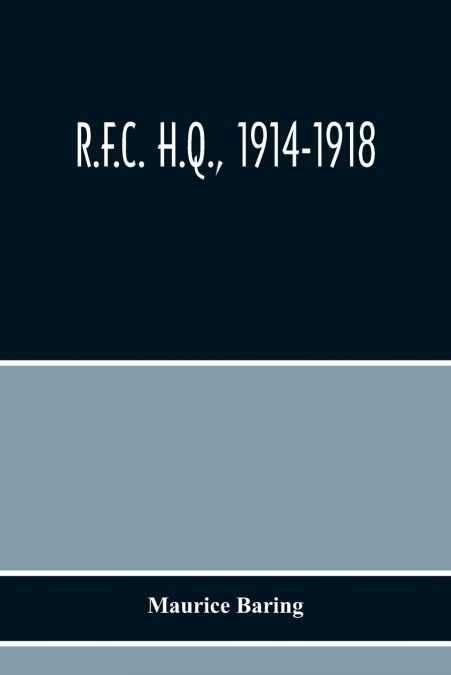
Inside the Royal Flying Corps headquarters, 1914-1918. A sharp witness to war. Maurice Baring’s R.F.C. H.Q., 1914-1918 stands apart as a quietly exact world war one memoir that records the day-to-day of command without grandeur or melodrama. Far from a battlefield chronicle, it is a wartime headquarters account: logistics and routine, counsel and command, the small decisions that shaped large consequences across early twentieth century Europe. Baring’s eye is precise and humane; the prose registers personalities, the protocols of service, and the bureaucratic realities that underpinned operations. Readers discover first-hand a cultured observer’s view of the Royal Flying Corps and the 1914-1918 British army, while the book’s measured style supplies both atmosphere and clarity. There are genuine military leadership insights here: subtle lessons about communication, authority and responsibility that make the volume useful for academic military studies as well as for anyone drawn to first world war experiences. For casual readers it offers human detail and readable narrative; for students and specialists it provides a reliable contemporary perspective.Valuable to historians and satisfying for general readers, Baring’s memoir occupies a distinct place in world war one literature: it is less an emotional memoir of combat and more a corrective view of life behind the desk where orders converged and policy took shape. Baring’s literary sensibility lends the account clarity and dignity, making administrative detail read as human story and allowing readers to understand the social rhythms of service in early twentieth century Europe. The book’s observations illuminate British military history and offer context for students, scholars and armchair readers alike; as such it complements official records and enriches academic military studies of the period. Republished by Alpha Editions in a careful modern edition, this volume preserves the spirit of the original while making it effortless to enjoy today, a heritage title prepared for readers and collectors alike. An essential entry for any Maurice Baring collection, it also makes an inspired history enthusiasts gift, accessible enough for casual reading and desirable for classic-literature collectors who prize provenance, voice and historical attestation.