Saurabh Chakravarty / Zhenya Antić
 Librería Samer Atenea
 Kálamo Books
 Librería Elías (Asturias)
 Librería Kolima (Madrid)
 Librería Proteo (Málaga)
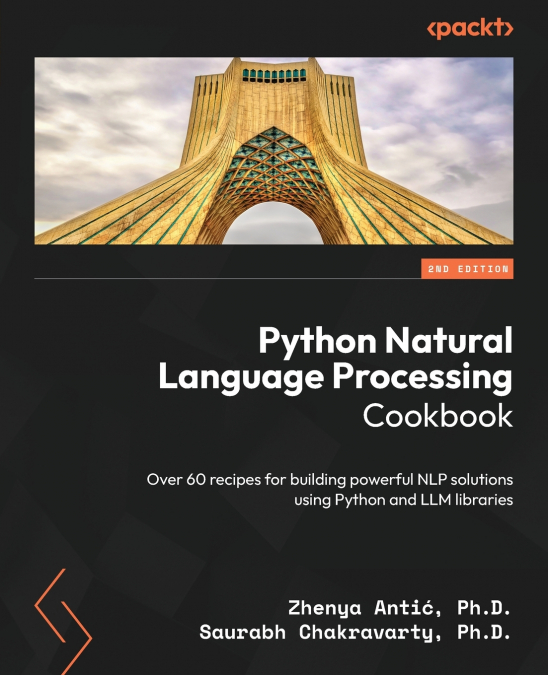
Updated to include three new chapters on transformers, natural language understanding (NLU) with explainable AI, and dabbling with popular LLMs from Hugging Face and OpenAIKey Features:- Leverage ready-to-use recipes with the latest LLMs, including Mistral, Llama, and OpenAI models- Use LLM-powered agents for custom tasks and real-world interactions- Gain practical, in-depth knowledge of transformers and their role in implementing various NLP tasks with open-source and advanced LLMs- Purchase of the print or Kindle book includes a free PDF eBookBook Description:Harness the power of Natural Language Processing (NLP) to overcome real-world text analysis challenges with this recipe-based roadmap written by two seasoned NLP experts with vast experience transforming various industries with their NLP prowess.You’ll be able to make the most of the latest NLP advancements, including large language models (LLMs), and leverage their capabilities through Hugging Face transformers. Through a series of hands-on recipes, you’ll master essential techniques such as extracting entities and visualizing text data. The authors will expertly guide you through building pipelines for sentiment analysis, topic modeling, and question-answering using popular libraries like spaCy, Gensim, and NLTK. You’ll also learn to implement RAG pipelines to draw out precise answers from a text corpus using LLMs.This second edition expands your skillset with new chapters on cutting-edge LLMs like GPT-4, Natural Language Understanding (NLU), and Explainable AI (XAI)-fostering trust in your NLP models.By the end of this book, you’ll be equipped with the skills to apply advanced text processing techniques, use pre-trained transformer models, build custom NLP pipelines to extract valuable insights from text data to drive informed decision-making.What You Will Learn:- Understand fundamental NLP concepts along with their applications using examples in Python- Classify text quickly and accurately with rule-based and supervised methods- Train NER models and perform sentiment analysis to identify entities and emotions in text- Explore topic modeling and text visualization to reveal themes and relationships within text- Leverage Hugging Face and OpenAI LLMs to perform advanced NLP tasks- Use question-answering techniques to handle both open and closed domains- Apply XAI techniques to better understand your model predictionsWho this book is for:This updated edition of the Python Natural Language Processing Cookbook is for data scientists, machine learning engineers, and developers with a background in Python. Whether you’re looking to learn NLP techniques, extract valuable insights from textual data, or create foundational applications, this book will equip you with basic to intermediate skills. No prior NLP knowledge is necessary to get started. All you need is familiarity with basic programming principles. For seasoned developers, the updated sections offer the latest on transformers, explainable AI, and Generative AI with LLMs.Table of Contents- Learning NLP Basics- Playing with Grammar- Representing Text - Capturing Semantics- Classifying Texts- Getting Started with Information Extraction- Topic Modeling- Visualizing Text Data- Transformers and Their Applications- Natural Language Understanding- Generative AI and Large Language Models