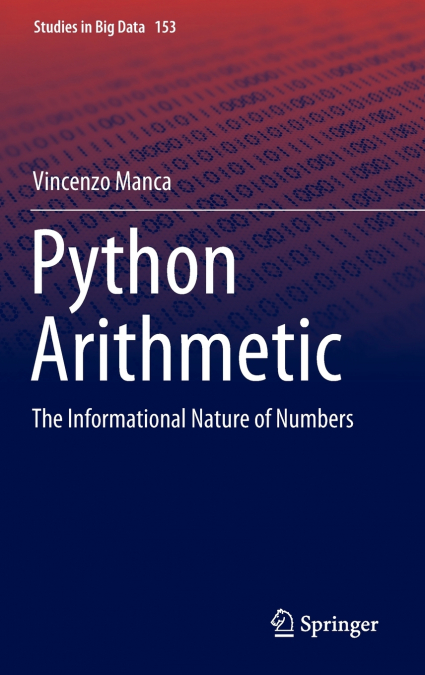

Python Arithmetic

Python Arithmetic

Vincenzo Manca

221,17 €
IVA incluido
Consulta disponibilidad
Editorial:
Springer Nature B.V.
Año de edición:
2024
Materia
Inteligencia artificial
ISBN:
9783031665448

Selecciona una librería:

  • Librería Samer Atenea
  • Librería Aciertas (Toledo)
  • Kálamo Books
  • Librería Perelló (Valencia)
  • Librería Elías (Asturias)
  • Donde los libros
  • Librería Kolima (Madrid)
  • Librería Proteo (Málaga)

The book is a gentle introduction to Python using arithmetic, and vice versa, with a historical perspective encompassing programming languages within the wider process of development of mathematical notation. The revisitation of typical algorithms that are the core of elementary mathematical knowledge helps to grasp their essence and to clarify some assumptions that are often taken for granted but are very profound and of a very general nature.The first mathematician to define a systematic system for generating numbers was Archimedes of Syracuse in the third century B.C. The Archimedean system, which was defined in a book with the Latin title Arenarius, was not intended to define all numbers, but only very large numbers [13, 22, 23]. However, it can be considered the first system with the three main characteristics of a counting system that have the most important properties for complete arithmetic adequacy: creativity, infinity, and recursion. Creativity means that each numeral is new for numerals that precede it; infinity means that after any numeral there is always another numeral; recursion means that after an initial sequence of numerals coinciding with the digits of the system, digits repeat regularly in all subsequent numerals. Since the numerals are finite expressions of digits, their lengths increase along their generation. In the next chapter, Python is briefly introduced by linking this language to standard mathematical notation, which took its current form throughout a long process that extends from the introduction of decimal numerals to the eighteenth century, particularly within Euler’s notational and conceptual framework. The third chapter is devoted to counting algorithms, showing that something that is usually taken for granted has intriguing aspects that deserve a very subtle analysis: the authors will show that the Python representation of counting algorithms is very informative and demonstrates the informational nature of numbers.
Artículos relacionados

  • Artificial Cognition Systems
    ...
  • Cross-Disciplinary Applications of Artificial Intelligence and Pattern Recognition
    Vijay Kumar Mago
    The need for intelligent machines in areas such as medical diagnostics, biometric security systems, and image processing motivates researchers to develop and explore new techniques, algorithms, and applications in this evolving field. Cross-Disciplinary Applications of Artificial Intelligence and Pattern Recognition: Advancing Technologies provides a common platform for researc...
  • Emerging Applications of Natural Language Processing
    Over the last few years, the area of Natural Language Processing has drastically grown in recognition, not only within the research and development community, but also with industry professionals. As NLP continues to be discussed and researched, certain areas continue to grow and mature. As a result, the need for advanced research and information is in high demand. Emerging App...
  • Androids, Cyborgs, and Robots in Contemporary Culture and Society
    Steven John Thompson
    Mankind’s dependence on artificial intelligence and robotics is increasing rapidly as technology becomes more advanced. Finding a way to seamlessly intertwine these two worlds will help boost productivity in society and aid in a variety of ways in modern civilization. Androids, Cyborgs, and Robots in Contemporary Culture and Society is an essential scholarly resource that delve...
  • Deep Learning Innovations and Their Convergence With Big Data
    The expansion of digital data has transformed various sectors of business such as healthcare, industrial manufacturing, and transportation. A new way of solving business problems has emerged through the use of machine learning techniques in conjunction with big data analytics. Deep Learning Innovations and Their Convergence With Big Data is a pivotal reference for the latest sc...
  • Computational Psychoanalysis and Formal Bi-Logic Frameworks
    Giuseppe Iurato
    Computational psychoanalysis is a new field stemming from Freudian psychoanalysis. The new area aims to understand the primary formal structures and running mechanisms of the unconscious while implementing them into computer sciences. Computational Psychoanalysis and Formal Bi-Logic Frameworks provides emerging information on this new field which uses psychoanalysis and the unc...

Otros libros del autor

  • Infobiotics
    Vincenzo Manca
    The book presents topics in discrete biomathematics. Mathematics has been widely used in modeling biological phenomena. However, the molecular and discrete nature of basic life processes suggests that their logic follow principles that are intrinsically based on discrete and informational mechanisms. The ultimate reason of polymers, as key element of life, is directly based on...
    Disponible

    210,42 €

  • Infobiotics
    Vincenzo Manca
    The book presents topics in discrete biomathematics. Mathematics has been widely used in modeling biological phenomena. However, the molecular and discrete nature of basic life processes suggests that their logic follow principles that are intrinsically based on discrete and informational mechanisms. The ultimate reason of polymers, as key element of life, is directly based on...