
Inicio > > Ciencias de la computación > Inteligencia artificial > Psychological and Neurological Consequences of AI
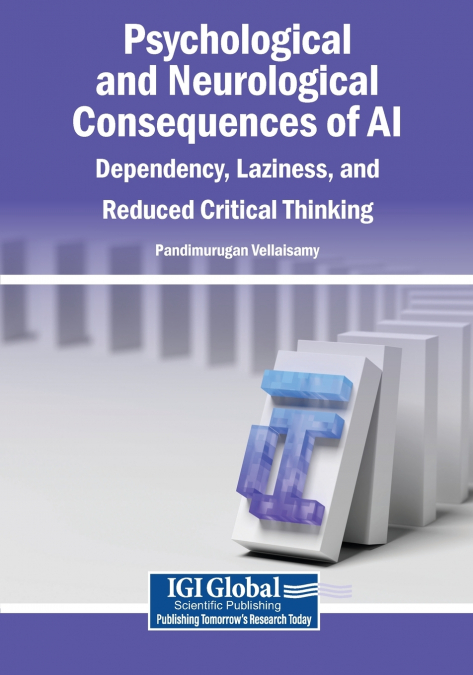
Psychological and Neurological Consequences of AI

Psychological and Neurological Consequences of AI

Pandimurugan Vellaisamy

248,89 €
IVA incluido
Disponible
Editorial:
IGI Global
Año de edición:
2026
Materia
Inteligencia artificial
ISBN:
9798337394855
248,89 €
IVA incluido
Disponible

Selecciona una librería:

  • Librería Samer Atenea

  • Kálamo Books
  • Librería Elías (Asturias)
  • Librería Kolima (Madrid)
  • Librería Proteo (Málaga)

Artificial intelligence has become deeply integrated into everyday life, influencing how people learn, work, make decisions, and solve problems. While AI technologies offer unprecedented convenience, efficiency, and access to information, growing concerns have emerged regarding their long-term effects on human cognition and behavior. As individuals increasingly rely on AI systems to perform tasks that once required memory, analysis, problem-solving, and independent judgment, important questions arise about the impact of this reliance on critical thinking, intellectual engagement, and cognitive development. These concerns extend beyond individual behavior to broader psychological and neurological implications that may shape how people process information and interact with the world around them. Understanding the potential benefits and unintended consequences of AI dependence has therefore become an important area of inquiry in an increasingly technology-driven society. Psychological and Neurological Consequences of AI: Dependency, Laziness, and Reduced Critical Thinking examines the psychological and neurological effects of increasing dependence on artificial intelligence, focusing on cognitive dependency, mental laziness, and reduced critical thinking. This book shifts the discussion from AI’s technical capabilities to its influence on the human mind, highlighting how prolonged AI use affects attention, memory, motivation, decision-making, and brain plasticity. Covering topics such as AI-induced cognitive atrophy, self-regulation under ai dependence, and the erosion of critical thinking, this book is an excellent academic resource for graduate and doctoral students, psychologists, counselors, therapists, mental health professionals, educators, teacher educators, academic leaders, technology developers, AI practitioners, policymakers, and more.
Artículos relacionados

  • Artificial Cognition Systems
    ...
  • Cross-Disciplinary Applications of Artificial Intelligence and Pattern Recognition
    Vijay Kumar Mago
    The need for intelligent machines in areas such as medical diagnostics, biometric security systems, and image processing motivates researchers to develop and explore new techniques, algorithms, and applications in this evolving field. Cross-Disciplinary Applications of Artificial Intelligence and Pattern Recognition: Advancing Technologies provides a common platform for researc...
  • Emerging Applications of Natural Language Processing
    Over the last few years, the area of Natural Language Processing has drastically grown in recognition, not only within the research and development community, but also with industry professionals. As NLP continues to be discussed and researched, certain areas continue to grow and mature. As a result, the need for advanced research and information is in high demand. Emerging App...
  • Androids, Cyborgs, and Robots in Contemporary Culture and Society
    Steven John Thompson
    Mankind’s dependence on artificial intelligence and robotics is increasing rapidly as technology becomes more advanced. Finding a way to seamlessly intertwine these two worlds will help boost productivity in society and aid in a variety of ways in modern civilization. Androids, Cyborgs, and Robots in Contemporary Culture and Society is an essential scholarly resource that delve...
  • Deep Learning Innovations and Their Convergence With Big Data
    The expansion of digital data has transformed various sectors of business such as healthcare, industrial manufacturing, and transportation. A new way of solving business problems has emerged through the use of machine learning techniques in conjunction with big data analytics. Deep Learning Innovations and Their Convergence With Big Data is a pivotal reference for the latest sc...
  • Computational Psychoanalysis and Formal Bi-Logic Frameworks
    Giuseppe Iurato
    Computational psychoanalysis is a new field stemming from Freudian psychoanalysis. The new area aims to understand the primary formal structures and running mechanisms of the unconscious while implementing them into computer sciences. Computational Psychoanalysis and Formal Bi-Logic Frameworks provides emerging information on this new field which uses psychoanalysis and the unc...