 Librería Samer Atenea
 Kálamo Books
 Librería Elías (Asturias)
 Librería Kolima (Madrid)
 Librería Proteo (Málaga)
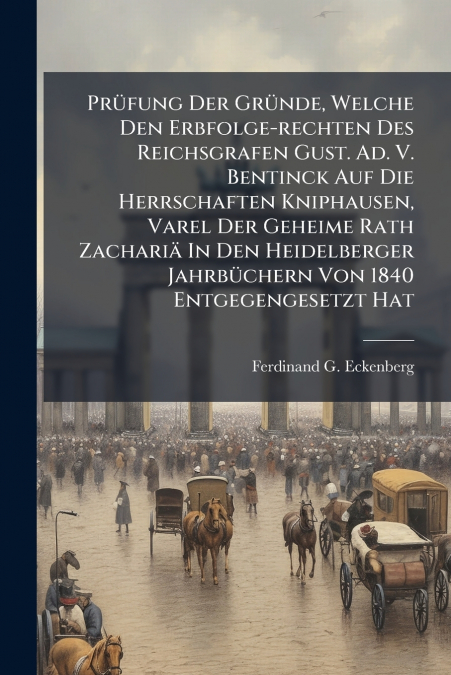
'Prüfung Der Gründe, Welche Den Erbfolge-rechten Des Reichsgrafen Gust. Ad. V. Bentinck Auf Die Herrschaften Kniphausen, Varel Der Geheime Rath Zachariä In Den Heidelberger Jahrbüchern Von 1840 Entgegengesetzt Hat' by Ferdinand G. Eckenberg, delves into the legal and historical arguments surrounding the inheritance rights of Reichsgraf Gust. Ad. V. Bentinck concerning the territories of Kniphausen and Varel. This book critically examines the objections raised by Geheimer Rath Zachariä in the Heidelberg Jahrbücher of 1840, offering a detailed analysis of the claims and counterclaims related to the succession. With meticulous attention to historical and legal documents, Eckenberg presents a compelling case, shedding light on the complexities of sovereignty, inheritance laws, and the political landscape of the time. This work will appeal to legal scholars, historians, and anyone interested in the intricate details of European succession disputes.This work has been selected by scholars as being culturally important, and is part of the knowledge base of civilization as we know it. This work was reproduced from the original artifact, and remains as true to the original work as possible. Therefore, you will see the original copyright references, library stamps (as most of these works have been housed in our most important libraries around the world), and other notations in the work.This work is in the public domain in the United States of America, and possibly other nations. Within the United States, you may freely copy and distribute this work, as no entity (individual or corporate) has a copyright on the body of the work.As a reproduction of a historical artifact, this work may contain missing or blurred pages, poor pictures, errant marks, etc. Scholars believe, and we concur, that this work is important enough to be preserved, reproduced, and made generally available to the public. We appreciate your support of the preservation process, and thank you for being an important part of keeping this knowledge alive and relevant.