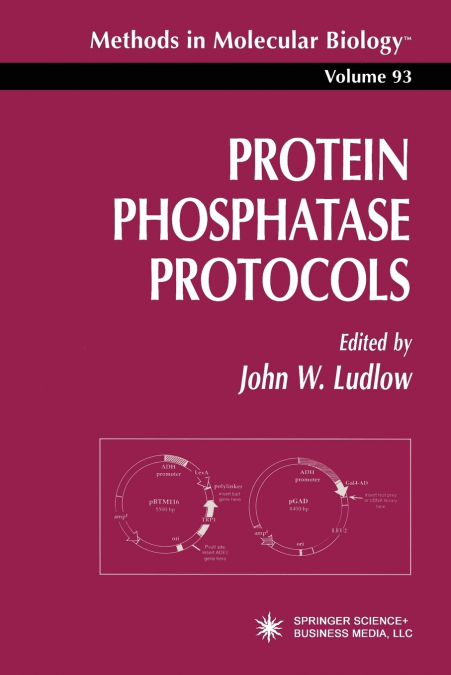
Protein Phosphatase Protocols

Protein Phosphatase Protocols

John W. Ludlow

132,56 €
IVA incluido
Consulta disponibilidad
Editorial:
Springer Nature B.V.
Año de edición:
1998
Materia
Biología molecular
ISBN:
9780896034686

Selecciona una librería:

  • Librería Samer Atenea
  • Librería Aciertas (Toledo)
  • Kálamo Books
  • Librería Perelló (Valencia)
  • Librería Elías (Asturias)
  • Donde los libros
  • Librería Kolima (Madrid)
  • Librería Proteo (Málaga)

A major mechanism by which cells regulate protein function is to place phosphate groups on serine and threonine residues. Though the steady-state level of protein phosphorylation depends on the relative activities of both kinases and phosphatases, a much greater effort has previously gone into the study of the former that the latter . Today, however, there is an increasing appreciation for the role that protein phosphatases play in the dynamic p- cess of protein phosphorylation . To date, there are four major types of protein serine/threonine phosphatase catalytic subunits, designated protein phosphatase type 1, 2A, 2B, and 2C . Each has been identified by the techniques of protein chemistry and enzymology and can be distinguished from one another by their preference for specific substrates as well as their sensitivity to certain acti- tors and inhibitors . Protein Phosphatase Protocols has been assembled in response to the growing interest these enzymes are receiving . The goal of this compilation is to provide a 'how-to' experimental guide to aid newcomers as well as s- soned veterans in their research endeavors, thus further contributing towards our ever increasing knowledge of serine/threonine phosphatases . What you have before you contains contributions by many of the current and emerging leaders in the field . To highlight just a few, these chapters c- tain step-by-step information on how to isolate novel phosphatases and re- latory subunits, assay for activity, and generate immunological reagents for both biochemical and biological characterization of these enzymes .


Artículos relacionados

  • DNA LOGIC DESIGN
    BABU HAFIZ MD. HASAN / Hafiz Md. Hasan Babu
    A DNA computer is a collection of specially selected DNA strands, which when encoded into specific combinations are then subjected to bio-molecular manipulation in order to solve computational problems. Rather than storing information in the 1s and 0s of the binary number system, it is now stored in the form of the bases adenine (A), thymine (T), cytosine (C) and guanine (G). T...
  • Vitamin Receptors
    Krishnamurti Dakshinamurti
    ...
    Disponible

    60,38 €

  • Regulación de la expresión génica de eucariotas
    Yenny Yolanda Lozano Jiménez
    En el amplio escenario de la biología celular, la regulación de la expresión génica emerge como un proceso vital que rige la vida de los organismos. Por ello, este libro sumerge al lector en el fascinante mundo donde cada célula coordina la activación y desactivación de genes para asegurar su funcionamiento y adaptación al entorno. Desde la interacción de factores de transcripc...
    Disponible

    26,00 €

  • Three-Dimensional Electron Microscopy of Macromolecular Assemblies
    Joachim Frank
    ...
    Disponible

    272,39 €

  • The Biochemistry of Inorganic Compounds of Sulphur
    A. B. Roy / ABRoy / P. A. Trudinger / PATrudinger
    ...
    Disponible

    77,03 €

  • Annotated Catalogue of African Grasshoppers
    H. B. Johnston / HBJohnston
    ...
    Disponible

    80,25 €

Otros libros del autor

  • Protein Phosphatase Protocols
    John W. Ludlow
    A major mechanism by which cells regulate protein function is to place phosphate groups on serine and threonine residues. Though the steady-state level of protein phosphorylation depends on the relative activities of both kinases and phosphatases, a much greater effort has previously gone into the study of the former that the latter . Today, however, ...
    Disponible

    133,71 €