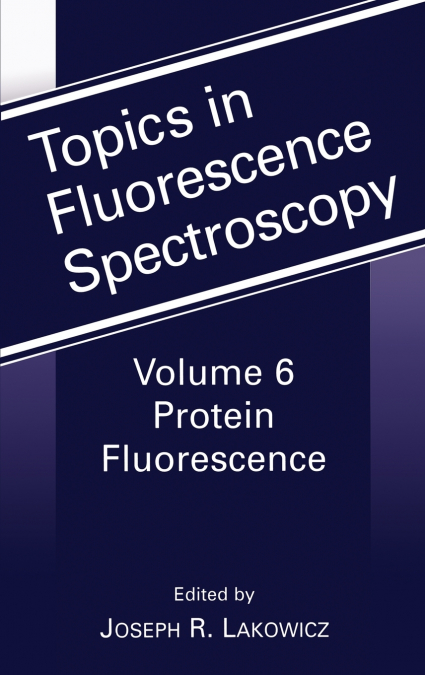
Protein Fluorescence

Protein Fluorescence

Joseph R. Lacowicz

207,48 €
IVA incluido
Disponible
Editorial:
Springer Nature B.V.
Año de edición:
2013
Materia
Bioquímica
ISBN:
9781475781946
207,48 €
IVA incluido
Disponible

Selecciona una librería:

  • Librería Samer Atenea
  • Librería Aciertas (Toledo)
  • Kálamo Books
  • Librería Perelló (Valencia)
  • Librería Elías (Asturias)
  • Donde los libros
  • Librería Kolima (Madrid)
  • Librería Proteo (Málaga)

The intrinsic or natural fluorescence of proteins is perhaps the most complex area of biochemical fluorescence. Fortunately the fluorescent amino acids, phenylalanine, tyrosine and tryptophan are relatively rare in proteins. Tr- tophan is the dominant intrinsic fluorophore and is present at about one mole % in protein. As a result most proteins contain several tryptophan residues and even more tyrosine residues. The emission of each residue is affected by several excited state processes including spectral relaxation, proton loss for tyrosine, rotational motions and the presence of nearby quenching groups on the protein. Additionally, the tyrosine and tryptophan residues can interact with each other by resonance energy transfer (RET) decreasing the tyrosine emission. In this sense a protein is similar to a three-particle or mul- particle problem in quantum mechanics where the interaction between particles precludes an exact description of the system. In comparison, it has been easier to interpret the fluorescence data from labeled proteins because the fluorophore density and locations could be controlled so the probes did not interact with each other. From the origins of biochemical fluorescence in the 1950s with Prof- sor G. Weber until the mid-1980s, intrinsic protein fluorescence was more qualitative than quantitative. An early report in 1976 by A. Grindvald and I. Z. Steinberg described protein intensity decays to be multi-exponential. Attempts to resolve these decays into the contributions of individual tryp- phan residues were mostly unsuccessful due to the difficulties in resolving closely spaced lifetimes.
Artículos relacionados

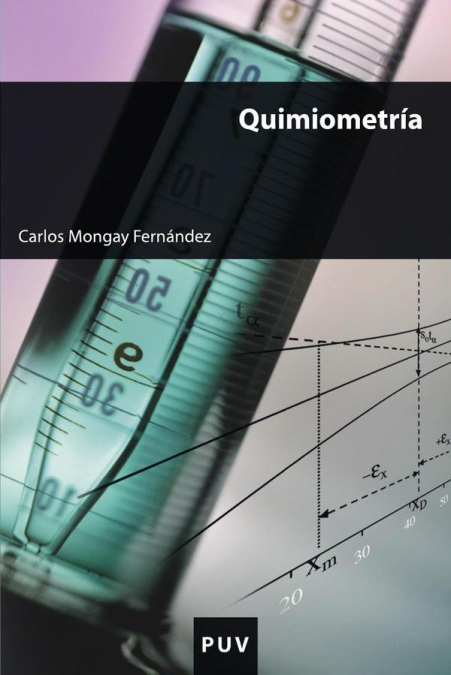
  • Quimiometría
    Carlos Mongay Fernández
    Es insólito que siendo la química analítica la ciencia de la medida química, estén tan descuidadas las bases en las que ésta se asienta y tan infrautilizadas las potencialidades que ofrecen diversas técnicas quimiométricas de trabajo. El presente manual plantea y discute esas bases de una forma sistemática: arranca con una rápida ojeada a los principios de la estadística, para ...
    Disponible

    30,00 €

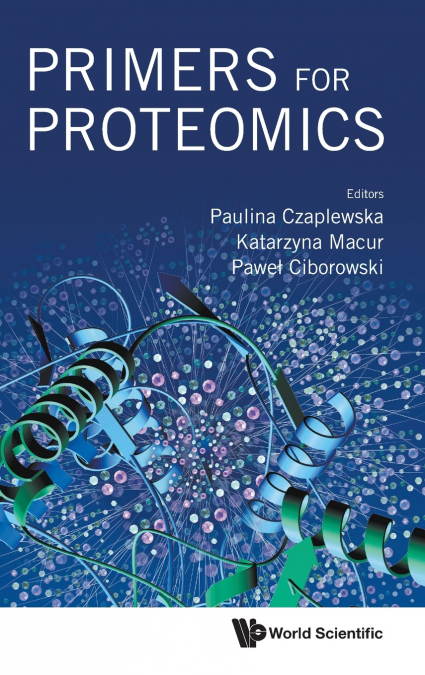
  • PRIMERS FOR PROTEOMICS
    CZAPLEWSKA PAULINA / KATARZYNA MACUR PAW PAULINA CZAPLEWSKA
    This book contains examples written by internationally recognized experts applying proteomics and analysis applications of mass spectrometry in their everyday research. They dedicate this book to a broad audience of all scientists to encourage them to use the omics approach to investigate biological processes.The first chapter is a short introduction to the basics of analytical...
  • Quality Assurance for the Analytical Chemistry Laboratory
    D. Brynn Hibbert
    ...
    Disponible

    100,42 €

  • Surfactants
    Laurier L. Schramm / Laurier LSchramm
    ...
  • Chemistry
    William B. Tucker
    Providing a holistic overview of general chemistry and its foundational principles, this textbook is an essential accompaniment to students entering the field. It is designed with the reader in mind, presenting the development of ideas to frame and center new concepts as well as providing sources for all topics covered. ...
  • Structure Determination By Spectroscopic Methods
    Maria Teresa Herrero / Raul SanMartin
    A number of increasingly more complex problems will act as trip segments, and in addition to the spectra themselves, each chapter is supplemented with figures and tables that decipher the above data and serve as maps for the journey. ...

Otros libros del autor

  • Protein Fluorescence
    Joseph R. Lacowicz
    The intrinsic or natural fluorescence of proteins is perhaps the most complex area of biochemical fluorescence. Fortunately the fluorescent amino acids, phenylalanine, tyrosine and tryptophan are relatively rare in proteins. Tr- tophan is the dominant intrinsic fluorophore and is present at about one mole % in protein. As a result most proteins contai...