
Protecting the Frontline in Biodefense Research

Protecting the Frontline in Biodefense Research

AA.VV

35,31 €
IVA incluido
Disponible
Editorial:
National Academies Press
Año de edición:
2011
Materia
Ciencias de la vida: cuestiones generales
ISBN:
9780309209243
35,31 €
IVA incluido
Disponible

Selecciona una librería:

  • Librería Samer Atenea
  • Librería Aciertas (Toledo)
  • Kálamo Books
  • Librería Perelló (Valencia)
  • Librería Elías (Asturias)
  • Donde los libros
  • Librería Kolima (Madrid)
  • Librería Proteo (Málaga)

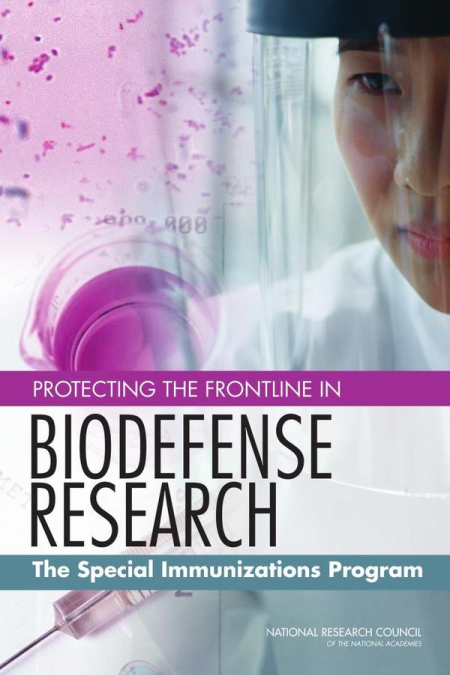
The U.S. Army’s Special Immunizations Program is an important component of an overall biosafety program for laboratory workers at risk of exposure to hazardous pathogens. The program provides immunizations to scientists, laboratory technicians and other support staff who work with certain hazardous pathogens and toxins. Although first established to serve military personnel, the program was expanded through a cost-sharing agreement in 2004 to include other government and civilian workers, reflecting the expansion in biodefense research in recent years. Protecting the Frontline in Biodefense Research examines issues related to the expansion of the Special Immunizations Program, considering the regulatory frameworks under which the vaccines are administered, how additional vaccines might be considered for inclusion in the Program, and factors that might influence the development and manufacturing of vaccines for the Special Immunizations Program.
Artículos relacionados

  • In the Light of Evolution
    In December 2006, the National Academy of Sciences sponsored a colloquium (featured as part of the Arthur M. Sackler Colloquia series) on ’Adaptation and Complex Design’ to synthesize recent empirical findings and conceptual approaches toward understanding the evolutionary origins and maintenance of complex adaptations. Darwin’s elucidation of natural selection as a creative na...
    Disponible

    73,32 €

  • Evaluation of a Site-Specific Risk Assessment for the Department of Homeland Security’s Planned National Bio- and Agro-Defense Facility in Manhattan, Kansas
    Congress requested that the U.S. Department of Homeland Security (DHS) produce a site-specific biosafety and biosecurity risk assessment (SSRA) of the proposed National Bio- and Agro-Defense Facility (NBAF) in Manhattan, Kansas. The laboratory would study dangerous foreign animal diseases—including the highly contagious foot-and-mouth disease (FMD), which affects cattle, pigs, ...
    Disponible

    43,63 €

  • In the Light of Evolution
    Biodiversity—the genetic variety of life—is an exuberant product of the evolutionary past, a vast human-supportive resource (aesthetic, intellectual, and material) of the present, and a rich legacy to cherish and preserve for the future. Two urgent challenges, and opportunities, for 21st-century science are to gain deeper insights into the evolutionary processes that foster bio...
    Disponible

    81,64 €

  • Evaluation of the Updated Site-Specific Risk Assessment for the National Bio- and Agro-Defense Facility in Manhattan, Kansas
    Safeguarding U.S. agriculture from foreign animal diseases and protecting our food system require cutting-edge research and diagnostic capabilities. The Department of Homeland Security (DHS) and the U.S. Department of Agriculture (USDA) have embarked on an important mission to replace the aging Plum Island Animal Disease Center (PIADC) with a new facility, the National Bio- and...
    Disponible

    36,35 €

  • The Science and Applications of Synthetic and Systems Biology
    Many potential applications of synthetic and systems biology are relevant to the challenges associated with the detection, surveillance, and responses to emerging and re-emerging infectious diseases. On March 14 and 15, 2011, the Institute of Medicine’s (IOM’s) Forum on Microbial Threats convened a public workshop in Washington, DC, to explore the current state of the science o...
    Disponible

    75,87 €

  • Life Sciences and Related Fields
    During the last decade, national and international scientific organizations have become increasingly engaged in considering how to respond to the biosecurity implications of developments in the life sciences and in assessing trends in science and technology (S&T) relevant to biological and chemical weapons nonproliferation. The latest example is an international workshop, Trend...
    Disponible

    37,96 €