Inicio > Sociedad y ciencias sociales > Educación pedagogía > Filosofía y teoría de la educación > Privatisation and Private Higher Education in Kenya. Implications for Access, Equity and Knowledge Production
Privatisation and Private Higher Education in Kenya. Implications for Access, Equity and Knowledge Production

Privatisation and Private Higher Education in Kenya. Implications for Access, Equity and Knowledge Production

Daniel M. Wesonga / Daniel MWesonga / Fatuma N. Chege / Fatuma NChege / Ibrahim Ogachi Oanda

54,15 €
IVA incluido
Disponible
Editorial:
African Books Collective
Año de edición:
2008
Materia
Filosofía y teoría de la educación
ISBN:
9782869782181
54,15 €
IVA incluido
Disponible

Selecciona una librería:

  • Librería Samer Atenea
  • Librería Aciertas (Toledo)
  • Kálamo Books
  • Librería Perelló (Valencia)
  • Librería Elías (Asturias)
  • Donde los libros
  • Librería Kolima (Madrid)
  • Librería Proteo (Málaga)

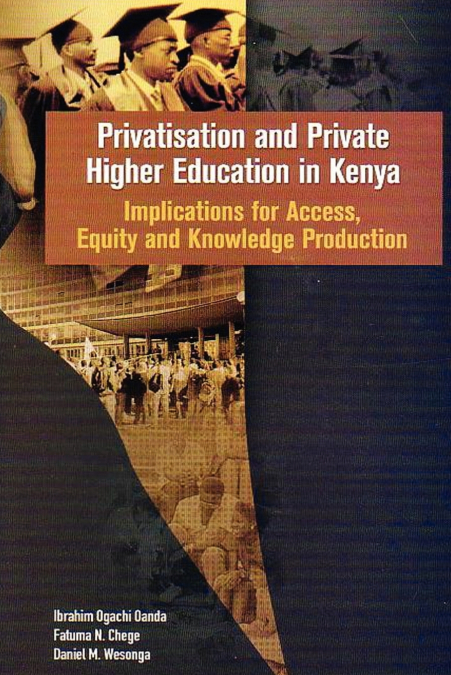
Over the last decade, the privatisation of public universities and the growth in the number of accredited private universities have picked up steadily in Kenya. The growth in the private university sector has been more in the number of institutions than in the volume of students, while in the public universities, privatisation has resulted in increased number of private students, whose enrollment in some institutions and programmes surpass the number of students on government sponsorship. This book addresses the implications of this development in Kenya, with regard to the responsiveness of private higher education to issues of broadening access, equity and the traditional research function of universities. Four tensions caused by the privatisation of universities in Kenya are raised in the book. First is the diminishing role of private higher education institutions as promoters of social equity, since access to the institutions and programmes is dependent of the ability to pay in a context where critical demand for university education comes from underprivileged groups. The second is the narrow definition of quality prevalent in private universities and programmes, against a context that demands broadened access and wider curriculum as a critical component of quality university education. Third is the dilemma of private universities focusing on low-captial intensive programmes when the development challenges of countries such as Kenya require investments in capital intensive science and technology oriented ones. The last tension discussed is the desire of universities in the developing world to proactively contribute to global knowledge economy when the imperatives of private university education restrict investments in basic research and knowledge production.
Artículos relacionados

  • Pragmatic Meditations on Learning Community Pedagogy
    Andrew J Weigert
    This groundbreaking book convincingly explains why a Learning Community Pedagogy (LCP) is a critical supplement to traditional teacher-student relation­ships. Based on a participatory democratic learning dynamic, LCP empowers both professor and student to discover themselves as present to one another, which generates freedom—an informing principle of the Learning Community.Thro...
    Disponible

    20,49 €

  • Global Challenges and Perspectives in Blended and Distance Learning
    Even in higher education, the traditional perception of learning is a face to face environment; while distance education is typically thought of as its alternative. However, the continuous expansion of technology has altered this point of view as a more flexible option of education, not an alternative. Global Challenges and Perspectives in Blended and Distance Learning highligh...
  • Open Learning and Formal Credentialing in Higher Education
    Amy Antonio / Mike Keppell / Shirley Reushle
    The discipline of education is a multi-faceted system that must constantly integrate new strategies and procedures to ensure successful learning experiences. Enhancements in education provide learners with greater opportunities for growth and advancement. Open Learning and Formal Credentialing in Higher Education: Curriculum Models and Institutional Policies is an authoritative...
  • Handbook of Research on Global Issues in Next-Generation Teacher Education
    There is no question that all aspects of modern life have been imbued with technology. In education, students are becoming increasingly savvy in their use of the myriad technologies and virtual tools and must be taught adequate complimentary skills to be effective in the 21st century workforce. To answer this call, teachers’ education must reflect modern demands by integrating ...
  • Creating a New Public University and Reviving Democracy
    Davydd J Greenwood / Morten Levin
    Public universities are in crisis, waning in their role as central institutions within democratic societies. Denunciations are abundant, but analyses of the causes and proposals to re-create public universities are not. Based on extensive experience with Action Research-based organizational change in universities and private sector organizations, Levin and Greenwood analyze the...
    Disponible

    38,08 €

  • Education, Migration, and Cultural Capital in the Chinese Diaspora
    Johanna Waters
    provides an important and timely contribution to an emergent body of work, reflecting increasing interest in the internationalisation of education and the transnational mobility of students worldwide. The last two decades have seen the dramatic expansion and consolidation of what has astutely been called an ’international education industry’, involving the increased marketisati...