Price Stabilization on World Agricultural Markets

Price Stabilization on World Agricultural Markets

Bernd Lucke

66,28 €
IVA incluido
Disponible
Editorial:
Springer Nature B.V.
Año de edición:
1992
Materia
Teoría y filosofía económicas
ISBN:
9783540560999
66,28 €
IVA incluido
Disponible

Selecciona una librería:

  • Librería Samer Atenea
  • Librería Aciertas (Toledo)
  • Kálamo Books
  • Librería Perelló (Valencia)
  • Librería Elías (Asturias)
  • Donde los libros
  • Librería Kolima (Madrid)
  • Librería Proteo (Málaga)

International commodity markets have traditionally attracted the attention of economists, econometricians, and policy makers especially in and following politically tumultuous times. For instance, the primary commodity price boom of 1973/74 and the subsequent period of highly volatile world market prices initiated increased research on commodity markets which quickly focused on possible price stabilization schemes, particularly on buffer stocks. Simultaneously, the issue clearly advanced in priority on the political agenda, such that the United Nations Conference on Trade and Development (UNCTAD) proposed an 'Integrated Program for Commodities' (IPC) intended to stabilize the world market prices of ten so-called 'core commodities'l (UNCTAD (1974, 1976a), Behrman (1979)). Many developing nations welcomed the IPC almost enthusiastically, but it did not receive more than lukewarm support by major industrialized countries, apparently due to the experience with some thirty international commodity agreements past World War II2. Critical evaluations have, among others, been presented by McNicol (1978), Gordon-Ashworth (1984), and Macbean & Nguyen (1987). The most detailed of these studies is Gordon-Ashworth’s, who concludes that 'on balance ... the performance of international commodity agreements has been too unreliable and their distributive effects too uneven to secure the development goals that have been set' (1984, p. 284)3. Consequently, the IPC turned out to be quite controversial a topic on the UNCTAD’s 1976 meeting in Nairobi and has not been able to gain any impetus since. lThese were cocoa, coffee, copper, cotton, jute, rubber, sisal, sugar, tea, and tin.
Artículos relacionados

  • Technological Change and the British Iron Industry, 1700-1870
    Charles K. Hyde
    This book describes technological change in an industry that played a central role in the Indsutrial Revolution. While earlier scholars have examined isolated aspects of ironmaking in the eighteenth- and nineteenth-century Britain, Charles Hyde surveys all aspects of its development. Costs, prices, profits, shrewd leaders, competition, new inventions, and productivity all figur...
    Disponible

    71,94 €

  • Corporate Governance in Asia
    ...
    Disponible

    72,99 €

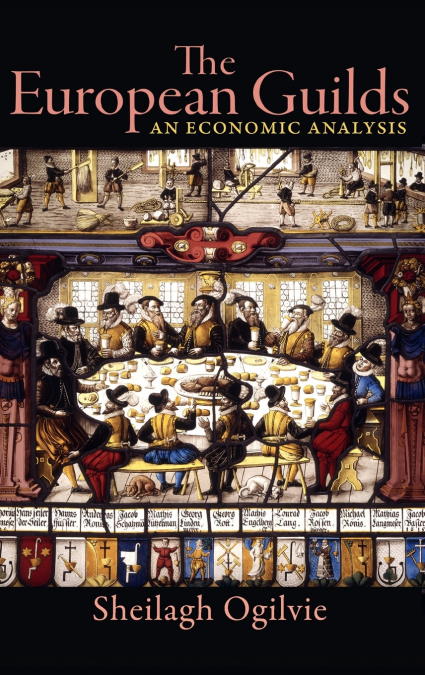
  • The European Guilds
    Sheilagh Ogilvie
    A comprehensive analysis of European craft guilds through eight centuries of economic historyGuilds ruled many crafts and trades from the Middle Ages to the Industrial Revolution, and have always attracted debate and controversy. They were sometimes viewed as efficient institutions that guaranteed quality and skills. But they also excluded competitors, manipulated markets, and ...
  • Technological Change and the British Iron Industry, 1700-1870
    Charles K. Hyde
    This book describes technological change in an industry that played a central role in the Indsutrial Revolution. While earlier scholars have examined isolated aspects of ironmaking in the eighteenth- and nineteenth-century Britain, Charles Hyde surveys all aspects of its development. Costs, prices, profits, shrewd leaders, competition, new inventions, and productivity all figur...
  • Technology Differences over Space and Time
    Francesco Caselli
    Technology Differences over Space and Time looks at how countries use their productive resources-such as workers, skills, equipment and structures, and natural resources. Francesco Caselli develops methods to assess the efficiency with which productive inputs are used, and how these efficiencies vary across countries and over time.Caselli finds that richer countries use skilled...
  • Cybersecurity Measures for Logistics Industry Framework
    Global supply chains are becoming more customer-centric and sustainable thanks to next-generation logistics management technologies. Automating logistics procedures greatly increases the productivity and efficiency of the workflow. There is a need, however, to create flexible and dynamic relationships among numerous stakeholders and the transparency and traceability of the supp...

Otros libros del autor

  • Theorie Und Empirie Realer Konjunkturzyklen
    Bernd Lucke
    In diesem Werk wird das Grundmodell der Real-Business-Cycle-Theorie einer ausführlichen empirischen Evaluation mit westdeutschen Daten der Jahre 1975-1994 unterzogen. Die Evaluation erfolgt anhand einer umfassenden Analyse der Zeitbereichimplikationen eines geeigneten kalibrierten Modells, nach spektralanalytischen Kriterien und mit dem methodischen I...
    Disponible

    71,91 €