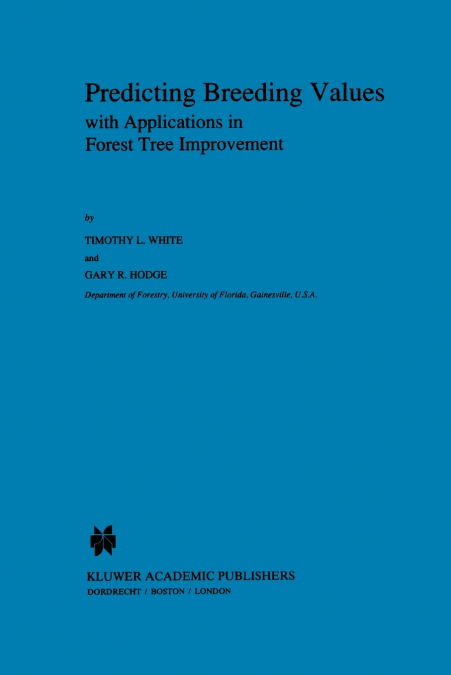

Predicting Breeding Values with Applications in Forest Tree Improvement

Predicting Breeding Values with Applications in Forest Tree Improvement

G.R. Hodge / T.L. White

267,36 €
IVA incluido
Consulta disponibilidad
Editorial:
Springer Nature B.V.
Año de edición:
1989
Materia
Agronomía y producción agrícola
ISBN:
9780792304609

Selecciona una librería:

  • Librería Samer Atenea
  • Librería Aciertas (Toledo)
  • Kálamo Books
  • Librería Perelló (Valencia)
  • Librería Elías (Asturias)
  • Donde los libros
  • Librería Kolima (Madrid)
  • Librería Proteo (Málaga)

In most breeding programs of plant and animal species, genetic data (such as data from field progeny tests) are used to rank parents and help choose candidates for selection. In general, all selection processes first rank the candidates using some function of the observed data and then choose as the selected portion those candidates with the largest (or smallest) values of that function. To make maximum progress from selection, it is necessary to use a function of the data that results in the candidates being ranked as closely as possible to the true (but always unknown) ranking. Very often the observed data on various candidates are messy and unbalanced and this complicates the process of developing precise and accurate rankings. For example, for any given candidate, there may be data on that candidate and its siblings growing in several field tests of different ages. Also, there may be performance data on siblings, ancestors or other relatives from greenhouse, laboratory or other field tests. In addition, data on different candidates may differ drastically in terms of quality and quantity available and may come from varied relatives. Genetic improvement programs which make most effective use of these varied, messy, unbalanced and ancestral data will maximize progress from all stages of selection. In this regard, there are two analytical techniques, best linear prediction (BLP) and best linear unbiased prediction (BLUP), which are quite well-suited to predicting genetic values from a wide variety of sources, ages, qualities and quantities of data.
Artículos relacionados

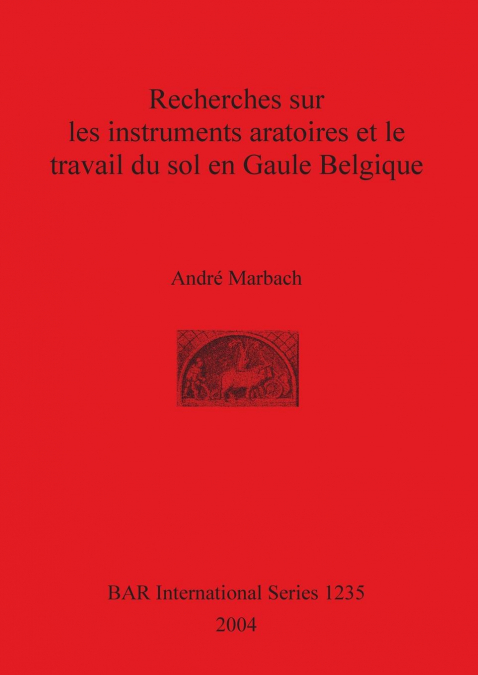
  • Recherches sur les instruments aratoires et le travail du sol en Gaule Belgique
    André Marbach
    A volume of detailed research and summary into metal farming tools used in Gaul/Upper Germania from the Gallo-Romano period; indeed many of the types are still in use today. 199 finds are investigated and reconstructed to show the various techniques of manufacture, use and efficiency. The new method of analysis has shown that ploughing equipment was capable of turning the soil ...
    Disponible

    109,47 €

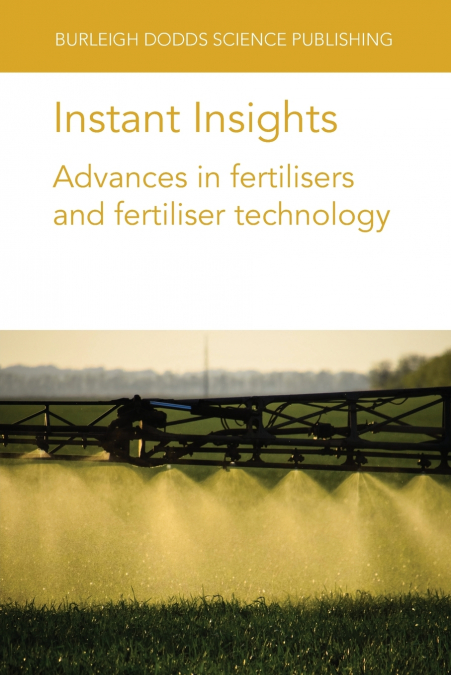
  • Instant Insights
    Bryan G Hopkins / Dan S Long / Dr Dan S. Long / Dr Paul Miller / Prof Bryan G. Hopkins
    This book provides a detailed overview of the history, current status and future needs of fertiliser developments in an era where sustainability is of paramount importance. Chapters also review recent advances in the use of fertiliser technologies, such as crop sprayers. ...
    Disponible

    69,64 €

  • Instant Insights
    Dr Roland Pieruschka / Dr Sherif Hamdy / Prof Ulrich Schurr / Thomas Vatter
    This book reviews recent advances in the application of phenotyping techniques to optimise crop breeding programmes. Chapters discuss the use of phenotyping as a means of improving crop yield, boosting genetic gain and identifying desirable traits in crop roots. ...
    Disponible

    69,69 €

  • FOOD SECURITY ISSUES IN ASIA
    Paul Teng / TENG PAUL
    Asia is not only the largest producer of important food items like rice and vegetable oil, but also the largest importer of commodities like soybeans and corn. Additionally, more than half the world’s population lives in Asia and thus the largest number of food insecure people are also in Asia. Food security is therefore a matter of paramount importance in Asia.This is the only...
  • Developing circular agricultural production systems
    Barbara Amon
    This collection summarises the wealth of research on the ways of achieving circular agricultural production systems through using minimal inputs, closing nutrient loops, reducing emissions and reusing and valorising agricultural wastes. ...
  • Improving nitrogen use efficiency in crop production
    Professor Cl Wagner-Riddle
    This collection reviews the wealth of research on ways of improving nitrogen use efficiency in crop production as a means of reducing the agricultural sector’s environmental impact and rebalancing the global nitrogen cycle. ...

Otros libros del autor

  • Predicting Breeding Values with Applications in Forest Tree Improvement
    G.R. Hodge / T.L. White
    In most breeding programs of plant and animal species, genetic data (such as data from field progeny tests) are used to rank parents and help choose candidates for selection. In general, all selection processes first rank the candidates using some function of the observed data and then choose as the selected portion those candidates with the largest (...
    Disponible

    268,74 €