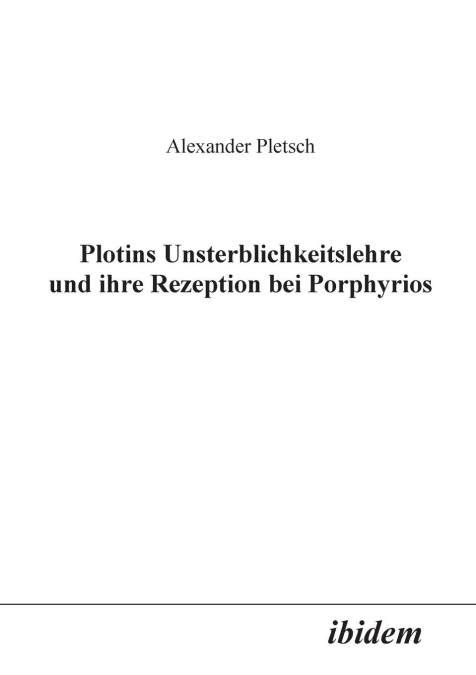

Plotins Unsterblichkeitslehre und ihre Rezeption bei Porphyrios.

Plotins Unsterblichkeitslehre und ihre Rezeption bei Porphyrios.

Plotins Unsterblichkeitslehre und ihre Rezeption bei Porphyrios.

Alexander Pletsch

37,95 €
IVA incluido
Disponible
Editorial:
ibidem
Año de edición:
2005
Materia
Filosofía occidental: antigua, hasta c. 500
ISBN:
9783898214445
37,95 €
IVA incluido
Disponible

Selecciona una librería:

  • Librería Samer Atenea
  • Librería Aciertas (Toledo)
  • Kálamo Books
  • Librería Perelló (Valencia)
  • Librería Elías (Asturias)
  • Donde los libros
  • Librería Kolima (Madrid)
  • Librería Proteo (Málaga)

Alexander Pletsch setzt sich mit den Einsichten des Neuplatonikers Plotin (205-270) in das Wesen des menschlichen Selbst auseinander und unternimmt den Versuch, die Aktualität von Plotins Schlüssen in das rechte Licht zu rücken. Im Mittelpunkt der Untersuchungen steht die Frage, wie Plotin seine These von der Unvergänglichkeit unseres denkenden Bewußtseinskerns begründet. Charakteristisch für Plotin ist die subtile Verknüpfung von akademischem, peripatetischem und stoischem Gedankengut mit Überlegungen, die als originär plotinisch einzustufen sind. Plotins Reflexionen über die Natur des menschlichen Geistes und Bewußtseins sowie die Konsequenzen, die sein Schüler Porphyrios daraus für die praktische Lebensgestaltung zieht, haben, wie ein Vergleich mit aktuellen Diskussionen zu diesen Themen zeigt, zeitlose Bedeutung. Sie können heutige Auseinandersetzungen mit diesen wichtigen philosophischen Problemen nachhaltig bereichern und sollten daher nicht übersehen werden.Der Leser wird von der Kraft der Argumentationsgänge Plotins, dessen Rang in der Geistesgeschichte noch nicht vollständig erkannt zu sein scheint, überrascht sein. Plotin verfolgt sein Beweisziel konzentriert, gedankenreich und mit bemerkenswerter Konsequenz. Seine Unsterblichkeitslehre ist eine Schule des Denkens und eine Schule des glücklichen Lebens zugleich, die mit der vorliegenden Arbeit bekannter gemacht werden soll.

Artículos relacionados

  • The Nature of Things
    Lucretius Lucretius
    De rerum natura (On the Nature of Things) is a 1st century BC didactic poem by the Roman poet and philosopher Lucretius with the goal of explaining Epicurean philosophy to a Roman audience. Lucretius presents the principles of atomism; the nature of the mind and soul; explanations of sensation and thought; the development of the world and its phenomena; and explains a variety o...
  • Pompeii
    Fergus Mason
    Pompeii was one of most advanced cities of its time; it had a complex water system, gymnasium, and an amphitheater. Despite it's advancements, there was one thing it wasn't ready for: Mount Vesuvius—the volcano that led to its ultimate doom.  The 79 AD eruption of Mount Vesuvius was one of the worst disasters in all of European history. In a near instant, over 15,000 p...
    Disponible

    10,36 €

  • Middle Platonism and Neoplatonism, Volume 1
    Stephen Gersh
    'It is generally agreed that those types of philosophy that are loosely called ’Platonic’ and ’Neoplatonic’ played a crucial role in the history of European culture during the centuries between antiquity and the Renaissance. However, until now no scholar has attempted to describe the evolution of these forms of thought in a single comprehensive academic study.' So writes Stephe...
  • Middle Platonism and Neoplatonism, Volume 2
    Stephen Gersh
    It is generally agreed that those types of philosophy that are loosely called 'Platonic' and 'Neoplatonic' played a crucial role in the history of European culture during the centuries between antiquity and the Middle Ages. However, until now no scholar has attempted to describe the evolution of these forms of thought in a single comprehensive academic study. Middle Platonism a...
  • Porphyry’s Commentary on Ptolemy’s Harmonics
    Andrew Barker
    ...
    Disponible

    77,17 €

  • The Roots of Platonism
    John Dillon
    ...
    Disponible

    25,29 €