 Librería Samer Atenea
 Kálamo Books
 Librería Elías (Asturias)
 Librería Kolima (Madrid)
 Librería Proteo (Málaga)
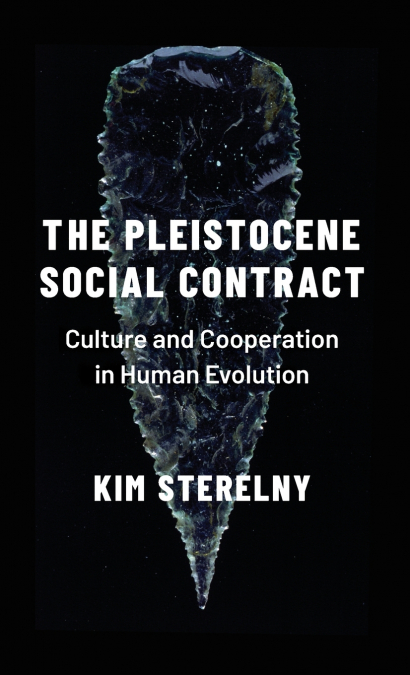
Kim Sterelny here builds on his original account of the evolutionary development and interaction of human culture and cooperation, which he first presented in The Evolved Apprentice (2012). Sterelny sees human evolution not as hinging on a single key innovation, but as emerging from a positivefeedback loop caused by smaller divergences from other great apes, including bipedal locomotion, better causal and social reasoning, reproductive cooperation, and changes in diet and foraging style. He advances this argument in The Pleistocene Social Contract with four key claims about cooperation, culture, and their interaction in human evolution. First, he proposes a new model of the evolution of human cooperation. He suggests human cooperation began from a baseline that was probably similar to that of great apes, advancing about 1.8 million years ago to an initial phase of cooperative forging, in small mobile bands. Second, he then presentsa novel account of the change in evolutionary dynamics of cooperation: from cooperation profits based on collective action and mutualism, to profits based on direct and indirect reciprocation over the course of the Pleistocene. Third, he addresses the question of normative regulation, or moralnorms, for band-scale cooperation, and connects it to the stabilization of indirect reciprocation as a central aspect of forager cooperation. Fourth, he develops an account of the emergence of inequality that links inequality to intermediate levels of conflict and cooperation: a final phase ofcooperation in largescale, hierarchical societies in the Holocene, beginning about 12,000 years ago. The Pleistocene Social Contract combines philosophy of biology with a reading of the archaeological and ethnographic record to present a new model of the evolution of human cooperation, cultural learning, and inequality.