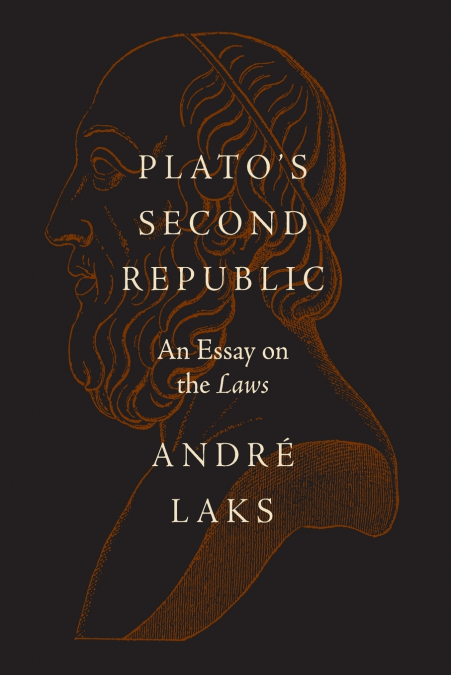

Plato’s Second Republic

Plato’s Second Republic

Andre Laks

29,53 €
IVA incluido
Disponible
Editorial:
Princeton University Press
Año de edición:
2025
Materia
Filosofía occidental: antigua, hasta c. 500
ISBN:
9780691236070
29,53 €
IVA incluido
Disponible

Selecciona una librería:

  • Librería Samer Atenea
  • Kálamo Books
  • Librería Elías (Asturias)
  • Librería Kolima (Madrid)
  • Librería Proteo (Málaga)

An argument for why Plato’s Laws can be considered his most important political dialogueIn Plato’s Second Republic, André Laks argues that the Laws, Plato’s last and longest dialogue, is also his most important political work, surpassing the Republic in historical relevance. Laks offers a thorough reappraisal of this less renowned text, and examines how it provides a critical foundation for the principles of lawmaking. In doing so, he makes clear the tremendous impact the Laws had not only on political philosophy, but also on modern political history.Laks shows how the four central ideas in the Laws—the corruptibility of unchecked power, the rule of law, a “middle” constitution, and the political necessity of legislative preambles—are articulated within an intricate and masterful literary architecture. He reveals how the work develops a theological conception of law anchored in political ideas about a god, divine reason, that is the measure of political order. Laks’s reading opens a complex analysis of the relationships between rulers and citizens; their roles in a political system; the power of reason and persuasion, as opposed to force, in commanding obedience; and the place of freedom.Plato’s Second Republic presents a sophisticated reevaluation of a philosophical work that has exerted an enormous if often hidden influence even into the present day.

Artículos relacionados

  • The Nature of Things
    Lucretius Lucretius
    De rerum natura (On the Nature of Things) is a 1st century BC didactic poem by the Roman poet and philosopher Lucretius with the goal of explaining Epicurean philosophy to a Roman audience. Lucretius presents the principles of atomism; the nature of the mind and soul; explanations of sensation and thought; the development of the world and its phenomena; and explains a variety o...
  • Pompeii
    Fergus Mason
    Pompeii was one of most advanced cities of its time; it had a complex water system, gymnasium, and an amphitheater. Despite it's advancements, there was one thing it wasn't ready for: Mount Vesuvius—the volcano that led to its ultimate doom.  The 79 AD eruption of Mount Vesuvius was one of the worst disasters in all of European history. In a near instant, over 15,000 p...
    Disponible

    10,36 €

  • Middle Platonism and Neoplatonism, Volume 1
    Stephen Gersh
    'It is generally agreed that those types of philosophy that are loosely called ’Platonic’ and ’Neoplatonic’ played a crucial role in the history of European culture during the centuries between antiquity and the Renaissance. However, until now no scholar has attempted to describe the evolution of these forms of thought in a single comprehensive academic study.' So writes Stephe...
  • Middle Platonism and Neoplatonism, Volume 2
    Stephen Gersh
    It is generally agreed that those types of philosophy that are loosely called 'Platonic' and 'Neoplatonic' played a crucial role in the history of European culture during the centuries between antiquity and the Middle Ages. However, until now no scholar has attempted to describe the evolution of these forms of thought in a single comprehensive academic study. Middle Platonism a...
  • Porphyry’s Commentary on Ptolemy’s Harmonics
    Andrew Barker
    ...
    Disponible

    80,87 €

  • The Roots of Platonism
    John Dillon
    ...
    Disponible

    26,54 €