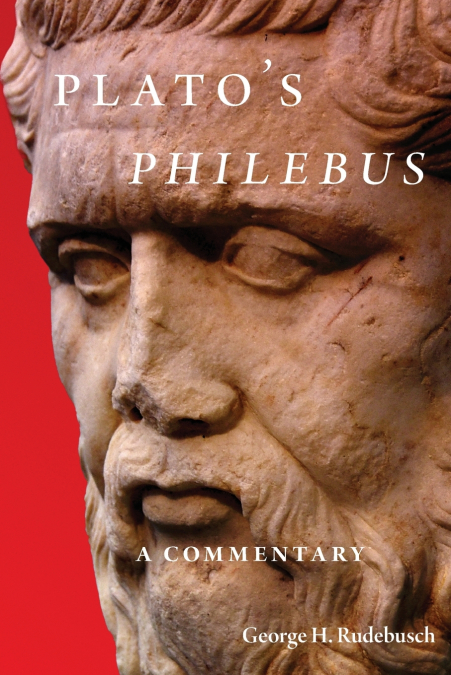

Plato’s Philebus

Plato’s Philebus

George H.. Rudebusch

27,59 €
IVA incluido
Disponible
Editorial:
University of Oklahoma Press
Año de edición:
2026
Materia
Filosofía occidental: antigua, hasta c. 500
ISBN:
9780806197531
27,59 €
IVA incluido
Disponible

Selecciona una librería:

  • Librería Samer Atenea
  • Kálamo Books
  • Librería Elías (Asturias)
  • Librería Kolima (Madrid)
  • Librería Proteo (Málaga)

Written in the fourth century BCE, Philebus is likely one of Plato’s last Socratic dialogues. It is also famously difficult to read and understand. A multilayered inquiry into the nature of life, Philebus has drawn renewed interest from scholars in recent years. Yet, until now, the only English-language commentary available has been a work published in 1897. This much-needed new commentary, designed especially for philosophers and advanced students of ancient Greek, draws on up-to-date scholarship to expand our understanding of Plato’s complex work.In his in-depth introduction, George Rudebusch places the Philebus in historical, philosophical, and linguistic context. As he explains, the dialogue deals with the question of whether a good life consists of pleasure or knowing. Yet its exploration of this question is riddled with ambiguity. With the goal of facilitating comprehension, particularly for students of philosophy, Rudebusch divides his commentary into twenty discrete subarguments. Within this framework, he elucidates the significance-and possible interpretations-of each passage and dissects their philological details. In particular, he analyzes how Plato uses inference indicators (that is, the Greek words for 'therefore' and 'because') to establish the structure of the arguments, markers difficult to present in translation.A detailed and thorough commentary, this volume is both easy to navigate and conducive to new interpretations of one of Plato’s most intriguing dialogues. 

Artículos relacionados

  • The Nature of Things
    Lucretius Lucretius
    De rerum natura (On the Nature of Things) is a 1st century BC didactic poem by the Roman poet and philosopher Lucretius with the goal of explaining Epicurean philosophy to a Roman audience. Lucretius presents the principles of atomism; the nature of the mind and soul; explanations of sensation and thought; the development of the world and its phenomena; and explains a variety o...
  • Pompeii
    Fergus Mason
    Pompeii was one of most advanced cities of its time; it had a complex water system, gymnasium, and an amphitheater. Despite it's advancements, there was one thing it wasn't ready for: Mount Vesuvius—the volcano that led to its ultimate doom.  The 79 AD eruption of Mount Vesuvius was one of the worst disasters in all of European history. In a near instant, over 15,000 p...
    Disponible

    10,36 €

  • Middle Platonism and Neoplatonism, Volume 1
    Stephen Gersh
    'It is generally agreed that those types of philosophy that are loosely called ’Platonic’ and ’Neoplatonic’ played a crucial role in the history of European culture during the centuries between antiquity and the Renaissance. However, until now no scholar has attempted to describe the evolution of these forms of thought in a single comprehensive academic study.' So writes Stephe...
  • Middle Platonism and Neoplatonism, Volume 2
    Stephen Gersh
    It is generally agreed that those types of philosophy that are loosely called 'Platonic' and 'Neoplatonic' played a crucial role in the history of European culture during the centuries between antiquity and the Middle Ages. However, until now no scholar has attempted to describe the evolution of these forms of thought in a single comprehensive academic study. Middle Platonism a...
  • Porphyry’s Commentary on Ptolemy’s Harmonics
    Andrew Barker
    ...
    Disponible

    80,87 €

  • The Roots of Platonism
    John Dillon
    ...
    Disponible

    26,54 €