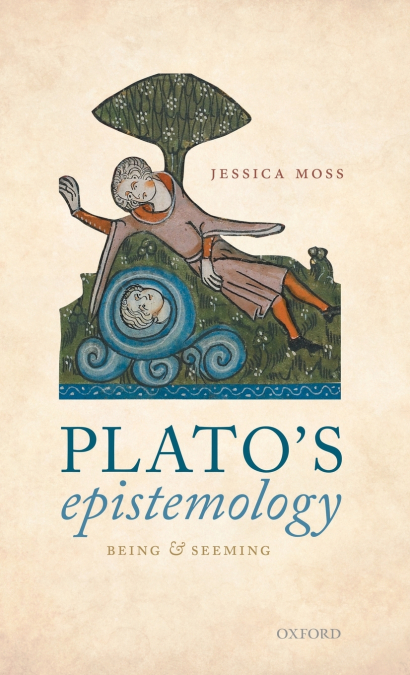

Plato’s Epistemology

Plato’s Epistemology

Jessica Moss

141,14 €
IVA incluido
Consulta disponibilidad
Editorial:
Oxford University Press
Año de edición:
2021
Materia
Filosofía occidental: antigua, hasta c. 500
ISBN:
9780198867401

Selecciona una librería:

  • Librería Samer Atenea
  • Librería Aciertas (Toledo)
  • Kálamo Books
  • Librería Perelló (Valencia)
  • Librería Elías (Asturias)
  • Donde los libros
  • Librería Kolima (Madrid)
  • Librería Proteo (Málaga)

Plato’s Epistemology: Being and Seeming presents an original interpretation of one of the central topics in Plato’s work: epistemology. Jessica Moss argues that Plato’s epistemology is radically different from our own. Going against the grain of recent scholarship, and drawing on ancient interpretations of Plato, Jessica Moss argues that Plato is not best understood as studying what we now call knowledge and belief. Instead, Moss proposes that the central players in his epistemology, epistÃÂamÃÂa and doxa, are each essentially to be understood as cognition of a certain kind of object. EpistÃÂamÃÂa is cognition of what Is - where this turns out to mean that it is a deep grasp of ultimate reality. Doxa is cognition of what seems - where this turns out to mean that it is atheoretical thought that mistakes images for reality. The book defends these characterizations by arguing that they explain important features of Plato’s epistemology. In particular, it shows that they underlie and make sense of a view which was long attributed to Plato but has recently been deemed 'outrageous' that there is no doxa of Forms, and no epistÃÂamÃÂa of perceptibles. Finally, Moss contends that Plato’s epistemology is so different from modern epistemology because it is motivated by his central ethical and metaphysical views. As the Cave allegory illustrates, he holds that the goal of life is to be in contact with genuine Being, and that the greatest obstacle to this goal is our tendency to rest content with appearances. Therefore, when Plato turns to epistemological investigations, the distinction he finds most salient is that between cognition of what Is and cognition of what seems.

Artículos relacionados

  • The Nature of Things
    Lucretius Lucretius
    De rerum natura (On the Nature of Things) is a 1st century BC didactic poem by the Roman poet and philosopher Lucretius with the goal of explaining Epicurean philosophy to a Roman audience. Lucretius presents the principles of atomism; the nature of the mind and soul; explanations of sensation and thought; the development of the world and its phenomena; and explains a variety o...
  • Pompeii
    Fergus Mason
    Pompeii was one of most advanced cities of its time; it had a complex water system, gymnasium, and an amphitheater. Despite it's advancements, there was one thing it wasn't ready for: Mount Vesuvius—the volcano that led to its ultimate doom.  The 79 AD eruption of Mount Vesuvius was one of the worst disasters in all of European history. In a near instant, over 15,000 p...
    Disponible

    10,36 €

  • Middle Platonism and Neoplatonism, Volume 1
    Stephen Gersh
    'It is generally agreed that those types of philosophy that are loosely called ’Platonic’ and ’Neoplatonic’ played a crucial role in the history of European culture during the centuries between antiquity and the Renaissance. However, until now no scholar has attempted to describe the evolution of these forms of thought in a single comprehensive academic study.' So writes Stephe...
  • Middle Platonism and Neoplatonism, Volume 2
    Stephen Gersh
    It is generally agreed that those types of philosophy that are loosely called 'Platonic' and 'Neoplatonic' played a crucial role in the history of European culture during the centuries between antiquity and the Middle Ages. However, until now no scholar has attempted to describe the evolution of these forms of thought in a single comprehensive academic study. Middle Platonism a...
  • Porphyry’s Commentary on Ptolemy’s Harmonics
    Andrew Barker
    ...
    Disponible

    77,17 €

  • The Roots of Platonism
    John Dillon
    ...
    Disponible

    25,29 €

Otros libros del autor