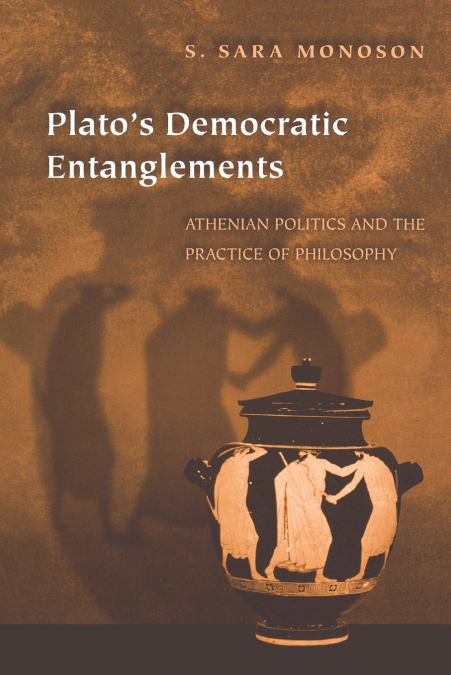
Plato’s Democratic Entanglements

Plato’s Democratic Entanglements

Plato’s Democratic Entanglements

S. Sara Monoson / SSara Monoson

45,99 €
IVA incluido
Disponible
Editorial:
Princeton University Press
Año de edición:
2013
Materia
Filosofía occidental: antigua, hasta c. 500
ISBN:
9780691158587
45,99 €
IVA incluido
Disponible

Selecciona una librería:

  • Librería Samer Atenea
  • Librería Aciertas (Toledo)
  • Kálamo Books
  • Librería Perelló (Valencia)
  • Librería Elías (Asturias)
  • Donde los libros
  • Librería Kolima (Madrid)
  • Librería Proteo (Málaga)

In this book, Sara Monoson challenges the longstanding and widely held view that Plato is a virulent opponent of all things democratic. She does not, however, offer in its place the equally mistaken idea that he is somehow a partisan of democracy. Instead, she argues that we should attend more closely to Plato’s suggestion that democracy is horrifying and exciting, and she seeks to explain why he found it morally and politically intriguing. Monoson focuses on Plato’s engagement with democracy as he knew it: a cluster of cultural practices that reach into private and public life, as well as a set of governing institutions. She proposes that while Plato charts tensions between the claims of democratic legitimacy and philosophical truth, he also exhibits a striking attraction to four practices central to Athenian democratic politics: intense antityrantism, frank speaking, public funeral oratory, and theater-going. By juxtaposing detailed examination of these aspects of Athenian democracy with analysis of the figurative language, dramatic structure, and arguments of the dialogues, she shows that Plato systematically links democratic ideals and activities to philosophic labor. Monoson finds that Plato’s political thought exposes intimate connections between Athenian democratic politics and the practice of philosophy. Situating Plato’s political thought in the context of the Athenian democratic imaginary, Monoson develops a new, textured way of thinking of the relationship between Plato’s thought and the politics of his city.


Artículos relacionados

  • The Nature of Things
    Lucretius Lucretius
    De rerum natura (On the Nature of Things) is a 1st century BC didactic poem by the Roman poet and philosopher Lucretius with the goal of explaining Epicurean philosophy to a Roman audience. Lucretius presents the principles of atomism; the nature of the mind and soul; explanations of sensation and thought; the development of the world and its phenomena; and explains a variety o...
  • Pompeii
    Fergus Mason
    Pompeii was one of most advanced cities of its time; it had a complex water system, gymnasium, and an amphitheater. Despite it's advancements, there was one thing it wasn't ready for: Mount Vesuvius—the volcano that led to its ultimate doom.  The 79 AD eruption of Mount Vesuvius was one of the worst disasters in all of European history. In a near instant, over 15,000 p...
    Disponible

    10,36 €

  • Middle Platonism and Neoplatonism, Volume 1
    Stephen Gersh
    'It is generally agreed that those types of philosophy that are loosely called ’Platonic’ and ’Neoplatonic’ played a crucial role in the history of European culture during the centuries between antiquity and the Renaissance. However, until now no scholar has attempted to describe the evolution of these forms of thought in a single comprehensive academic study.' So writes Stephe...
  • Middle Platonism and Neoplatonism, Volume 2
    Stephen Gersh
    It is generally agreed that those types of philosophy that are loosely called 'Platonic' and 'Neoplatonic' played a crucial role in the history of European culture during the centuries between antiquity and the Middle Ages. However, until now no scholar has attempted to describe the evolution of these forms of thought in a single comprehensive academic study. Middle Platonism a...
  • Porphyry’s Commentary on Ptolemy’s Harmonics
    Andrew Barker
    ...
    Disponible

    77,17 €

  • The Roots of Platonism
    John Dillon
    ...
    Disponible

    25,29 €

Otros libros del autor

  • Plato’s Democratic Entanglements
    S. Sara Monoson / SSara Monoson
    In this book, Sara Monoson challenges the longstanding and widely held view that Plato is a virulent opponent of all things democratic. She does not, however, offer in its place the equally mistaken idea that he is somehow a partisan of democracy. Instead, she argues that we should attend more closely to Plato’s suggestion that democracy is horrifying and exciting, and she seek...