
Inicio > Humanidades > Filosofía > Historia de la filosofía occidental > Filosofía occidental: antigua, hasta c. 500 > Platonis Leges Et Epinomis, Emendavit Et Perpetua Adnotatione Illustr. F. Astius
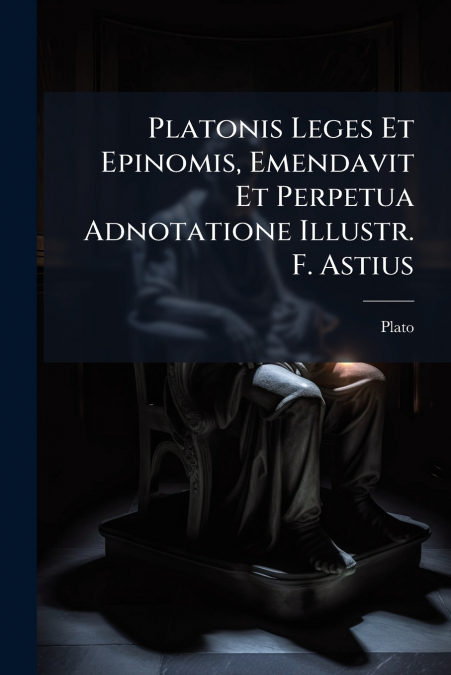
Platonis Leges Et Epinomis, Emendavit Et Perpetua Adnotatione Illustr. F. Astius

Platonis Leges Et Epinomis, Emendavit Et Perpetua Adnotatione Illustr. F. Astius

Plato

32,66 €
IVA incluido
Disponible
Editorial:
Nabu Press
Año de edición:
2010
Materia
Filosofía occidental: antigua, hasta c. 500
ISBN:
9781145384279
32,66 €
IVA incluido
Disponible

Selecciona una librería:

  • Librería Samer Atenea

  • Kálamo Books
  • Librería Elías (Asturias)
  • Librería Kolima (Madrid)
  • Librería Proteo (Málaga)

This volume contains Plato’s 'Laws' and 'Epinomis', meticulously edited and annotated by F. Astius. A cornerstone of classical political philosophy, 'Laws' presents Plato’s later thoughts on the ideal state, detailing laws and institutions designed to promote virtue and social harmony. Supplementing 'Laws', the 'Epinomis' explores practical wisdom and the application of philosophical principles to governance. This edition, with its comprehensive annotations, offers invaluable insights into the nuances of Plato’s thought and its enduring relevance to contemporary political and ethical debates. It remains an essential resource for scholars and students seeking a deeper understanding of ancient Greek philosophy and its lasting impact on Western civilization.This work has been selected by scholars as being culturally important, and is part of the knowledge base of civilization as we know it. This work was reproduced from the original artifact, and remains as true to the original work as possible. Therefore, you will see the original copyright references, library stamps (as most of these works have been housed in our most important libraries around the world), and other notations in the work.This work is in the public domain in the United States of America, and possibly other nations. Within the United States, you may freely copy and distribute this work, as no entity (individual or corporate) has a copyright on the body of the work.As a reproduction of a historical artifact, this work may contain missing or blurred pages, poor pictures, errant marks, etc. Scholars believe, and we concur, that this work is important enough to be preserved, reproduced, and made generally available to the public. We appreciate your support of the preservation process, and thank you for being an important part of keeping this knowledge alive and relevant.


Artículos relacionados

  • The Nature of Things
    Lucretius Lucretius
    De rerum natura (On the Nature of Things) is a 1st century BC didactic poem by the Roman poet and philosopher Lucretius with the goal of explaining Epicurean philosophy to a Roman audience. Lucretius presents the principles of atomism; the nature of the mind and soul; explanations of sensation and thought; the development of the world and its phenomena; and explains a variety o...
  • Pompeii
    Fergus Mason
    Pompeii was one of most advanced cities of its time; it had a complex water system, gymnasium, and an amphitheater. Despite it's advancements, there was one thing it wasn't ready for: Mount Vesuvius—the volcano that led to its ultimate doom.  The 79 AD eruption of Mount Vesuvius was one of the worst disasters in all of European history. In a near instant, over 15,000 p...
    Disponible

    12,45 €

  • Middle Platonism and Neoplatonism, Volume 1
    Stephen Gersh
    'It is generally agreed that those types of philosophy that are loosely called ’Platonic’ and ’Neoplatonic’ played a crucial role in the history of European culture during the centuries between antiquity and the Renaissance. However, until now no scholar has attempted to describe the evolution of these forms of thought in a single comprehensive academic study.' So writes Stephe...
  • Middle Platonism and Neoplatonism, Volume 2
    Stephen Gersh
    It is generally agreed that those types of philosophy that are loosely called 'Platonic' and 'Neoplatonic' played a crucial role in the history of European culture during the centuries between antiquity and the Middle Ages. However, until now no scholar has attempted to describe the evolution of these forms of thought in a single comprehensive academic study. Middle Platonism a...
  • Porphyry’s Commentary on Ptolemy’s Harmonics
    Andrew Barker
    ...
    Disponible

    91,02 €

  • The Roots of Platonism
    John Dillon
    ...
    Disponible

    29,89 €

Otros libros del autor

  • Cratylus
    Plato
    Does a name reveal what something truly is—or only what people agree to call it? A familiar word becomes a philosophical puzzle in this searching dialogue about language and truth.In Cratylus, Plato brings Socrates into conversation with Hermogenes and Cratylus over the correctness of names. Hermogenes grounds naming in convention and agreement; Cratylus argues that names posse...
  • Philebus: Large Print
    Plato
    Is the happiest life the one with the most pleasure—or the one guided by reason? What if neither, on its own, is enough?In Philebus, Plato turns the question of human happiness into a searching philosophical conversation. Socrates and Protarchus debate the claims of pleasure and intelligence, testing whether either can supply everything a good life requires. Their inquiry moves...
  • The Republic
    Plato
    Why be just when injustice seems to pay? Plato turns that unsettling question into a searching debate about power, truth, and how we should live.In The Republic, Socrates and his companions investigate justice by imagining a city and asking what would make it well governed. Their conversation moves between public life and the inner life: the education of guardians, the responsi...
  • The Republic: Large Print
    Plato
    Why be just when injustice seems to pay? Plato turns that unsettling question into a searching debate about power, truth, and how we should live.In The Republic, Socrates and his companions investigate justice by imagining a city and asking what would make it well governed. Their conversation moves between public life and the inner life: the education of guardians, the responsi...
  • Phaedrus
    Plato
    What makes love a path to wisdom—and persuasion more than a clever use of words? A walk outside Athens becomes a searching conversation about desire, truth, and the human soul.In Plato’s Phaedrus, Socrates joins a young admirer of speeches beside the river Ilissus. A speech by Lysias sparks a debate about lovers and those who do not love, leading Socrates to reconsider love as ...
  • Phaedrus: Large Print
    Plato
    What makes love a path to wisdom—and persuasion more than a clever use of words? A walk outside Athens becomes a searching conversation about desire, truth, and the human soul.In Plato’s Phaedrus, Socrates joins a young admirer of speeches beside the river Ilissus. A speech by Lysias sparks a debate about lovers and those who do not love, leading Socrates to reconsider love as ...