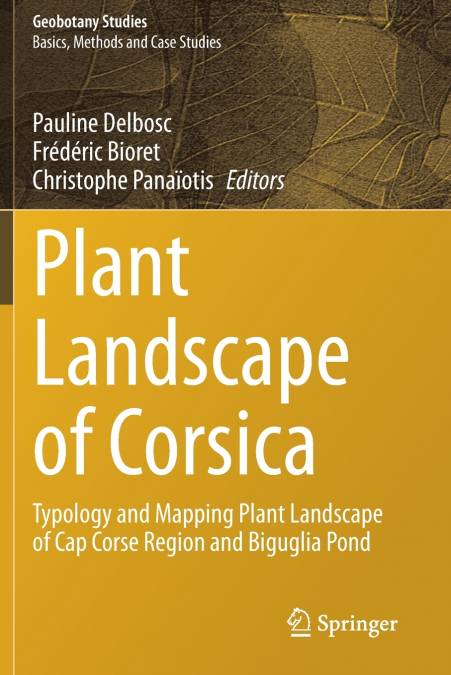

Plant Landscape of Corsica

Plant Landscape of Corsica


136,03 €
IVA incluido
Disponible
Editorial:
Springer Nature B.V.
Año de edición:
2021
Materia
Geografía
ISBN:
9783030357788
136,03 €
IVA incluido
Disponible

Selecciona una librería:

  • Librería Samer Atenea
  • Librería Aciertas (Toledo)
  • Kálamo Books
  • Librería Perelló (Valencia)
  • Librería Elías (Asturias)
  • Donde los libros
  • Librería Kolima (Madrid)
  • Librería Proteo (Málaga)

Since the 1970s and particularly the works of Tüxen (1978) and Géhu & Rivas-Martínez (1981), dynamico-catenal phytosociology has facilitated the integration of vegetation dynamics by more precisely describing the trajectories of vegetation series. A national habitat mapping program (CarHAB), launched by France’s Ministry of Ecology, aims to map the vegetation and vegetation series of metropolitan France at a scale of 1: 25,000 by 2025. In this context, Corsica has been selected as a pilot region, due to its unique characteristics regarding Mediterranean and alticole vegetation.This book describes in detail the vegetation series and geoseries (ecology, structure, dynamic trajectories, effects of anthropogenic factors on vegetation dynamics, catenal positioning in the landscape) of two Corsican sectors: Cap Corse and Biguglia pond. These two study sites were selected using two methods:•             For Cap Corse, the typology and mapping are based on an inductive approach, which seeks to understand the dynamics of vegetation by drawing on the mature, substitutional, pioneering and anthropogenic associations likely to exist within a tessellar envelope. These various dynamic stages characterize 'the vegetation series' (sigmetum or synassociation), the fundamental unit of symphytosociology (Géhu 2006; Biondi 2011). The aim of symphytosociology is, therefore, to define the vegetation series; in other words, it seeks to identify the repetitive combinations of syntaxa under homogeneous ecological conditions.•             For Biguglia pond, the typology and mapping are based on a deductive approach, which combines (under SIG) the ecological descriptor maps with the vegetation mapping, in order to reveal the tesselas and the natural potential vegetation that underlies them. Thanks to the improvement of GIS techniques, this approach has been frequently used to characterize plant landscapes from vegetation to vegetation geoseries since the 2000s, with applications to the conservation management of natural and semi-natural environments.
Artículos relacionados

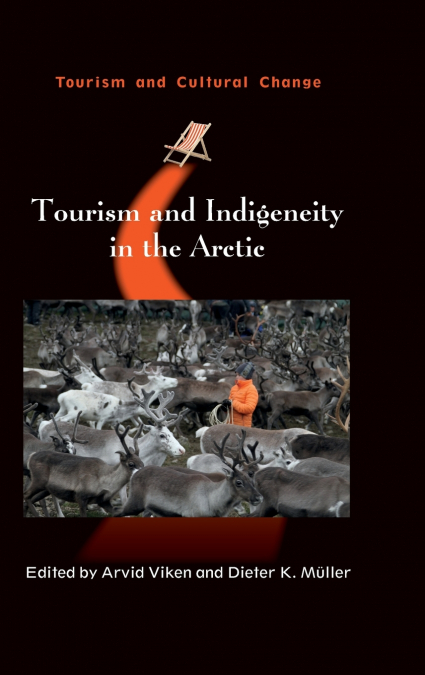
  • Tourism and Indigeneity in the Arctic
    This is the first book to exclusively address tourism and indigenous peoples in the circumpolar North. It examines how tourism in indigenous communities is influenced by academic and political discourses, and how these communities are influenced by tourism. The volume focuses on the ambivalence relating to tourism as a modern force within ethnic groups who are concerned with ma...
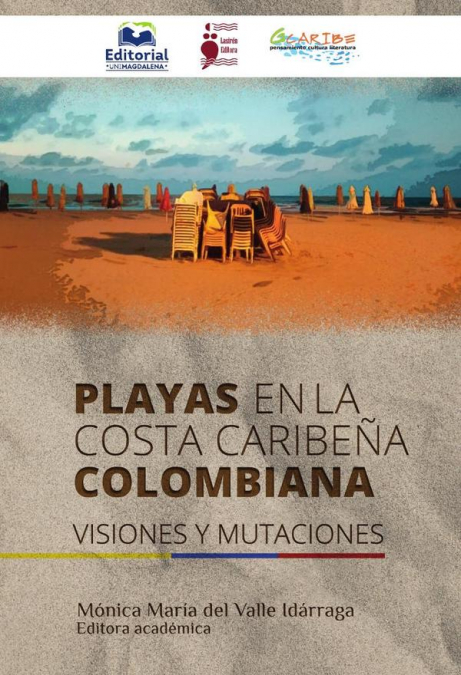
  • Playas en la costa caribeña colombiana
    Diva Marcela Piamba Tulcán / Eduardo Silva Peña / Eliana Díaz Muñoz / Juliana Javierre / Mónica María Del Valle Idárraga / Yessica Chiquillo
    En este libro, reconstruimos el surgimiento y transformación de varias playas del hoy llamado Caribe colombiano, como playas turísticas, entre 1950 y 1990. Mediante un análisis de archivos periodísticos y audiovisuales y de narraciones de Amira de la Rosa, Jaime Manrique, Fanny Buitrago, Tomás González, entre otros, desanudamos el cronotopo playas, tomando como foco Prado Mar y...
    Disponible

    20,75 €

  • Sustainable Water Management
    Miklas Scholz
    The collection is comprised of 40 reprinted articles grouped into six sections. Section 1 is concerned with the interface between climate change, water resources and public health. The water-related impacts of climate change on agriculture and, subsequently, on public health are also assessed. Agricultural water management is covered in Section 2. Novel water retention and nutr...
  • Sustainable Water Management
    Miklas Scholz
    The collection is comprised of 40 reprinted articles grouped into six sections. Section 1 is concerned with the interface between climate change, water resources and public health. The water-related impacts of climate change on agriculture and, subsequently, on public health are also assessed. Agricultural water management is covered in Section 2. Novel water retention and nutr...
  • Agricultural farming practices in the face of climate change
    Nougbodjingni Damien Makponse
    In recent years, the land pact region has experienced the vulnerability and adverse effects of climate change. This research analyses the adaptation strategies used by farmers to improve their living conditions. The methodology used consists of collecting, processing and analysing results based on 120 farmers in two districts of each commune. The field results reveal that the i...
    Disponible

    48,30 €

  • FACTEURS ENVIRONNEMENTAUX ET DÉVELOPPEMENT ÉCONOMIQUE
    Huda Abdul Rahim Abdul Kadir
    Les facteurs environnementaux qui nous entourent sont nombreux, les hommes, les animaux et les plantes en sont affectés, et affectent l’activité et la capacité de production, ainsi que l’économie de la vie qui en est affectée sous différents aspects. L’effet de ces facteurs se reflète clairement sur l’agriculture générale et comprend de nombreux types de produits, y compris les...
    Disponible

    54,38 €