 Librería Samer Atenea
 Kálamo Books
 Librería Elías (Asturias)
 Librería Kolima (Madrid)
 Librería Proteo (Málaga)
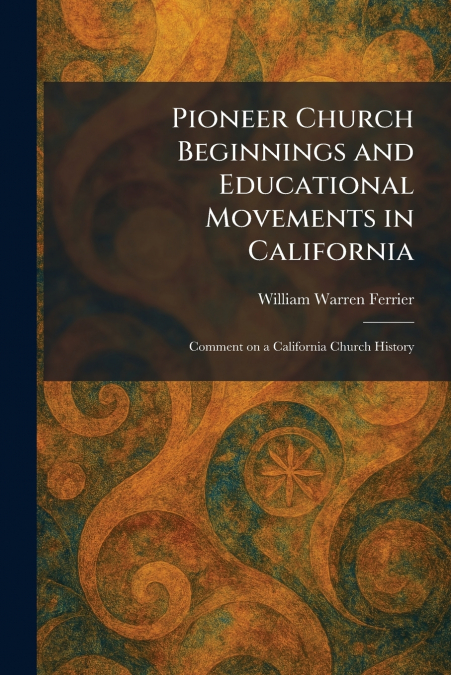
'Pioneer Church Beginnings and Educational Movements in California' provides an authoritative look at the foundational intersection of faith and learning in the American West. This work meticulously documents the establishment of religious institutions and the development of educational systems during California’s formative years. The narrative explores how early pioneer efforts laid the groundwork for the state’s cultural and spiritual identity, tracing the growth of diverse denominations and their pivotal roles in creating schools and colleges.William Warren Ferrier offers a scholarly commentary on California church history, providing invaluable context for the social and moral evolution of the region. By examining the tireless work of early settlers and religious leaders, the book highlights the challenges and triumphs of building a civil society in a rapidly expanding frontier. This volume is an essential resource for historians of the West, researchers of ecclesiastical development, and anyone interested in the social history of California. It serves as a vital record of the ideological and organizational forces that shaped the Golden State.This work has been selected by scholars as being culturally important, and is part of the knowledge base of civilization as we know it. This work was reproduced from the original artifact, and remains as true to the original work as possible. Therefore, you may see the original copyright references, library stamps (as most of these works have been housed in our most important libraries around the world), and other notations in the work.This work is in the public domain in the United States of America, and possibly other nations. Within the United States, you may freely copy and distribute this work, as no entity (individual or corporate) has a copyright on the body of the work.As a reproduction of a historical artifact, this work may contain missing or blurred pages, poor pictures, errant marks, etc. Scholars believe, and we concur, that this work is important enough to be preserved, reproduced, and made generally available to the public. We appreciate your support of the preservation process, and thank you for being an important part of keeping this knowledge alive and relevant.