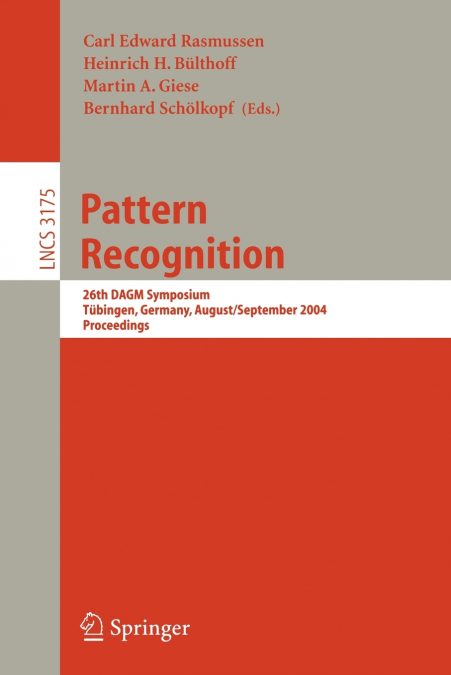

Pattern Recognition

Pattern Recognition


64,79 €
IVA incluido
Disponible
Editorial:
Springer Nature B.V.
Año de edición:
2004
Materia
Inteligencia artificial
ISBN:
9783540229452
64,79 €
IVA incluido
Disponible

Selecciona una librería:

  • Librería Samer Atenea
  • Librería Aciertas (Toledo)
  • Kálamo Books
  • Librería Perelló (Valencia)
  • Librería Elías (Asturias)
  • Donde los libros
  • Librería Kolima (Madrid)
  • Librería Proteo (Málaga)

We are delighted to present the proceedings of DAGM 2004, and wish to - press our gratitude to the many people whose e?orts made the success of the conference possible. We received 146 contributions of which we were able to - cept 22 as oral presentations and 48 as posters. Each paper received 3 reviews, upon which decisions were based. We are grateful for the dedicated work of the 38 members of the program committee and the numerous referees. The careful review process led to the exciting program which we are able to present in this volume. Among the highlights of the meeting were the talks of our four invited spe- ers, renowned experts in areas spanning learning in theory, in vision and in robotics: - William T. Freeman, Arti?cial Intelligence Laboratory, MIT: Sharing F- tures for Multi-class Object Detection - PietroPerona,Caltech:TowardsUnsupervisedLearningofObjectCategories - StefanSchaal,DepartmentofComputerScience,UniversityofSouthernC- ifornia: Real-Time Statistical Learning for Humanoid Robotics - Vladimir Vapnik, NEC Research Institute: Empirical Inference WearegratefulforeconomicsupportfromHondaResearchInstituteEurope, ABW GmbH, Transtec AG, DaimlerChrysler, and Stemmer Imaging GmbH, which enabled us to ?nance best paper prizes and a limited number of travel grants. Many thanks to our local support Sabrina Nielebock and Dagmar Maier, who dealt with the unimaginably diverse range of practical tasks involved in planning a DAGM symposium. Thanks to Richard van de Stadt for providing excellent software and support for handling the reviewing process. A special thanks goes to Jeremy Hill, who wrote and maintained the conference website.
Artículos relacionados

  • Artificial Cognition Systems
    ...
  • Cross-Disciplinary Applications of Artificial Intelligence and Pattern Recognition
    Vijay Kumar Mago
    The need for intelligent machines in areas such as medical diagnostics, biometric security systems, and image processing motivates researchers to develop and explore new techniques, algorithms, and applications in this evolving field. Cross-Disciplinary Applications of Artificial Intelligence and Pattern Recognition: Advancing Technologies provides a common platform for researc...
  • Emerging Applications of Natural Language Processing
    Over the last few years, the area of Natural Language Processing has drastically grown in recognition, not only within the research and development community, but also with industry professionals. As NLP continues to be discussed and researched, certain areas continue to grow and mature. As a result, the need for advanced research and information is in high demand. Emerging App...
  • Androids, Cyborgs, and Robots in Contemporary Culture and Society
    Steven John Thompson
    Mankind’s dependence on artificial intelligence and robotics is increasing rapidly as technology becomes more advanced. Finding a way to seamlessly intertwine these two worlds will help boost productivity in society and aid in a variety of ways in modern civilization. Androids, Cyborgs, and Robots in Contemporary Culture and Society is an essential scholarly resource that delve...
  • Deep Learning Innovations and Their Convergence With Big Data
    The expansion of digital data has transformed various sectors of business such as healthcare, industrial manufacturing, and transportation. A new way of solving business problems has emerged through the use of machine learning techniques in conjunction with big data analytics. Deep Learning Innovations and Their Convergence With Big Data is a pivotal reference for the latest sc...
  • Computational Psychoanalysis and Formal Bi-Logic Frameworks
    Giuseppe Iurato
    Computational psychoanalysis is a new field stemming from Freudian psychoanalysis. The new area aims to understand the primary formal structures and running mechanisms of the unconscious while implementing them into computer sciences. Computational Psychoanalysis and Formal Bi-Logic Frameworks provides emerging information on this new field which uses psychoanalysis and the unc...