Papyrus Ebers

Papyrus Ebers

Cyril P. Bryan

23,85 €
IVA incluido
Consulta disponibilidad
Editorial:
Lushena Books
Año de edición:
2021
Materia
Sociedad y cultura: general
ISBN:
9781639233670

Selecciona una librería:

  • Librería Samer Atenea
  • Librería Aciertas (Toledo)
  • Kálamo Books
  • Librería Perelló (Valencia)
  • Librería Elías (Asturias)
  • Donde los libros
  • Librería Kolima (Madrid)
  • Librería Proteo (Málaga)

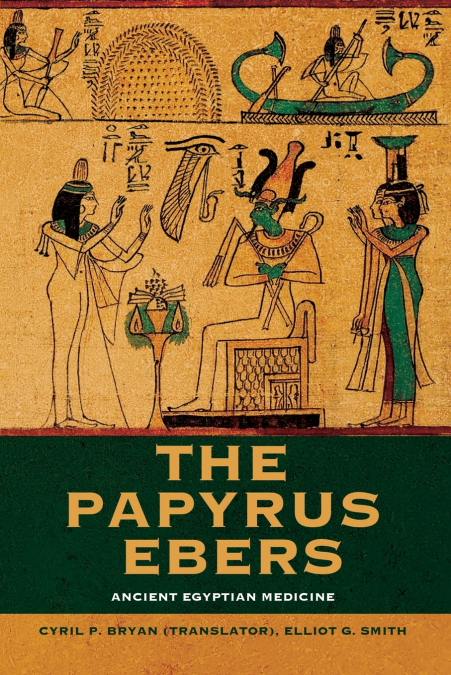
The Ebers Papyrus, also known as Papyrus Ebers, is an Egyptian medical papyrus of herbal knowledge dating to circa 1550 BC. Among the oldest and most important medical papyri of ancient Egypt, it was purchased at Luxor in the winter of 1873-74 by Georg Ebers. It is currently kept at the library of the University of Leipzig, in Germany. The Ebers Papyrus is written in hieratic Egyptian writing and represents the most extensive and best-preserved record of ancient Egyptian medicine known. The scroll contains some 700 magical formulas and folk remedies. It contains many incantations meant to turn away disease-causing demons and there is also evidence of a long tradition of empiricism. The papyrus contains a 'treatise on the heart'. It notes that the heart is the center of the blood supply, with vessels attached for every member of the body. Mental disorders are detailed in a chapter of the papyrus called the Book of Hearts. Disorders such as depression and dementia are covered. The descriptions of these disorders suggest that Egyptians conceived of mental and physical diseases in much the same way. The papyrus contains chapters on contraception, diagnosis of pregnancy and other gynecological matters, intestinal disease and parasites, eye and skin problems, dentistry and the surgical treatment of abscesses and tumors, bone-setting and burns. The 'channel theory' was prevalent at the time of writing of the Ebers papyrus; it suggested that unimpeded flow of bodily fluids is a prerequisite for good health. It may be a considered a precursor of ancient Greek humoral pathology and the subsequently established theory of the four humors, providing a historical connection between Ancient Egypt, ancient Greece, and medieval medicine.


Artículos relacionados

  • The Gandhian Iceberg
    Chris D Moore-Backman
    The Gandhian Iceberg presents a bold, new interpretation of Gandhian nonviolence from the rare perspective of an author who is equal parts writer, scholar, and frontlines practitioner. The book faces the current crisis of climate change and the intensification of social unrest around the world, and calls for a new convergence of serious, spiritually-rooted US nonviolence activi...
    Disponible

    11,52 €

  • Contemporary Developments in Child Protection
    Nigel Parton
    Volume 1 "Policy Changes and Challenges" takes as its central theme the ongoing and challenging issues which child protection agencies have to address and the policy and practice initiatives that are developed to try and address these. The volume includes papers on: the relationship between the decline in the rate of ‘unnatural’ deaths and the growth of concern about child abus...
  • Diversity in Information Technology Education
    Goran Trajkovski
    ...
  • Model-Driven Software Development
    Model-driven software development (MDSD) drastically alters the software development process, characterized by a high degree of innovation and productivity. However, quality assurance application in the domain of software models and model-driven software development is still in an emergent phase. Model-Driven Software Development: Integrating Quality Assurance provides in-depth...
  • Evidence-Based Practice in Nursing Informatics
    Andrew Chasin
    Because of the constant advances and dynamics within the nascent field of nursing informatics, many nurses struggle in practice as they continue to try and apply habitual communication practices in the new environment without any critical reflection on, and adaptation of, those practices. Evidence-Based Practice in Nursing Informatics: Concepts and Applications serves as a valu...
  • Actor-Network Theory and Technology Innovation
    Arthur Tatnall
    About 25 years ago, the first developments of ANT (Actor-Network Theory) took place, but it wasn’t until much later that researchers began to take it seriously. In the late 1990s, ANT began to take hold in the scientific community as a new and exciting approach to socio-technical research and social theory. Actor-Network Theory and Technology Innovation: Advancements and New Co...