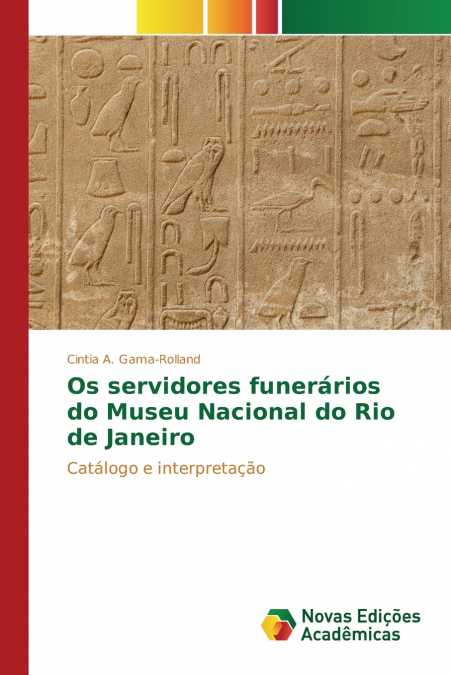

Os servidores funerários do Museu Nacional do Rio de Janeiro

Os servidores funerários do Museu Nacional do Rio de Janeiro

Gama-Rolland Cintia A.

115,85 €
IVA incluido
Disponible
Editorial:
KS OmniScriptum Publishing
Año de edición:
2015
Materia
Filosofía occidental: antigua, hasta c. 500
ISBN:
9783639616064
115,85 €
IVA incluido
Disponible

Selecciona una librería:

  • Librería Samer Atenea
  • Librería Aciertas (Toledo)
  • Kálamo Books
  • Librería Perelló (Valencia)
  • Librería Elías (Asturias)
  • Donde los libros
  • Librería Kolima (Madrid)
  • Librería Proteo (Málaga)

O uso da magia para suprir as necessidades do morto, e melhorar a sua existência na vida após a morte, levou à criação de um numeroso grupo de imagens no equipamento funerário. Dentre estas estão as estatuetas funerárias que são conhecidas por três nomes alternativos shabti, chauabti e ushabti. O significado das estatuetas era complexo, e mudou com o passar do tempo. Desde a substituição da função dos antigos modelos, estas estatuetas possuem um caráter de servas do morto ou, mais ainda, agem como um substituto pessoal para o seu mestre. A fonte básica para este trabalho são os 244 servidores funerários da Coleção egípcia do Museu Nacional do Rio de janeiro. Num pano de fundo mágico-religioso e tipológico, este material foi analisado levando-se em conta o seu uso no contexto funerário, que vai do Médio Império até o Período Ptolomaico. Buscamos entender, por meio das estatuetas funerárias, as crenças egípcias relacionadas com o Além.

Artículos relacionados

  • The Nature of Things
    Lucretius Lucretius
    De rerum natura (On the Nature of Things) is a 1st century BC didactic poem by the Roman poet and philosopher Lucretius with the goal of explaining Epicurean philosophy to a Roman audience. Lucretius presents the principles of atomism; the nature of the mind and soul; explanations of sensation and thought; the development of the world and its phenomena; and explains a variety o...
  • Pompeii
    Fergus Mason
    Pompeii was one of most advanced cities of its time; it had a complex water system, gymnasium, and an amphitheater. Despite it's advancements, there was one thing it wasn't ready for: Mount Vesuvius—the volcano that led to its ultimate doom.  The 79 AD eruption of Mount Vesuvius was one of the worst disasters in all of European history. In a near instant, over 15,000 p...
    Disponible

    10,36 €

  • Middle Platonism and Neoplatonism, Volume 1
    Stephen Gersh
    'It is generally agreed that those types of philosophy that are loosely called ’Platonic’ and ’Neoplatonic’ played a crucial role in the history of European culture during the centuries between antiquity and the Renaissance. However, until now no scholar has attempted to describe the evolution of these forms of thought in a single comprehensive academic study.' So writes Stephe...
  • Middle Platonism and Neoplatonism, Volume 2
    Stephen Gersh
    It is generally agreed that those types of philosophy that are loosely called 'Platonic' and 'Neoplatonic' played a crucial role in the history of European culture during the centuries between antiquity and the Middle Ages. However, until now no scholar has attempted to describe the evolution of these forms of thought in a single comprehensive academic study. Middle Platonism a...
  • Porphyry’s Commentary on Ptolemy’s Harmonics
    Andrew Barker
    ...
    Disponible

    77,17 €

  • The Roots of Platonism
    John Dillon
    ...
    Disponible

    25,29 €