
Origin of Humor

Origin of Humor

Ozmioz

95,40 €
IVA incluido
Disponible
Editorial:
iUniverse
Año de edición:
2026
Materia
Sociedad y cultura: general
ISBN:
9781663278623
95,40 €
IVA incluido
Disponible

Selecciona una librería:

  • Librería Samer Atenea

  • Kálamo Books
  • Librería Elías (Asturias)
  • Librería Kolima (Madrid)
  • Librería Proteo (Málaga)

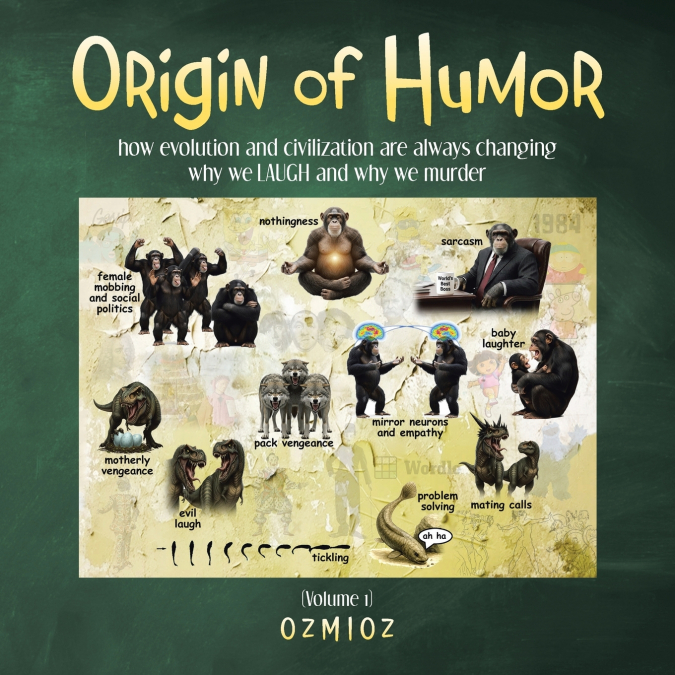
During the Covid Pandemic we stumbled upon I. M. Suslov’s revolutionary idea that considers humor from the brain’s perspective. In summary, humor helps us forget 'incorrect' inputs, making us smarter. For artificial intelligence programmers, this suggests that humor helps eliminate AI hallucinations. There is one snag with this theory. We remember jokes. But Suslov’s insight sparked our curiosity.The more we read, the more we discovered numerous people have studied humor from all kinds of perspectives. This list includes Aristotle, Freud, and Darwin. We soon realized all theories of humor fail at some level. No one really knows why we laugh. We then asked the question, 'How is our voice box wired up to our brain?' We should have never asked that question. That question, along with our background as a camera designer who is also interested in self-driving car systems, led us down a six-year odyssey. We spent two to three hours every morning digesting over 1,000 research papers while reverse engineering how our brain is wired together. We discovered there are multiple competing paths from our brain to our voice box. One path is for speech, the others for laughter.We discovered the power of 'mirror neurons' and the origin of empathy. We deciphered the neurological wiring between long-term, short-term, and working memory. We figured out how combative humor, nurturing humor, and sexual humor work at a system level. Also, how resonances amplify laughter when we recall memories with old friends. We then applied Darwin’s 'Theory of Opposites' and studied the evil laugh. By accident we discovered deaths from war and genocide have the same statistics as earthquakes. Unfortunately, these statistics predict 2 to 3 billion people will die this century. Description of the evil laugh is in Volume I. Statistical details are in Volume II.


Artículos relacionados

  • The Gandhian Iceberg
    Chris D Moore-Backman
    The Gandhian Iceberg presents a bold, new interpretation of Gandhian nonviolence from the rare perspective of an author who is equal parts writer, scholar, and frontlines practitioner. The book faces the current crisis of climate change and the intensification of social unrest around the world, and calls for a new convergence of serious, spiritually-rooted US nonviolence activi...
    Disponible

    11,52 €

  • Contemporary Developments in Child Protection
    Nigel Parton
    Volume 1 "Policy Changes and Challenges" takes as its central theme the ongoing and challenging issues which child protection agencies have to address and the policy and practice initiatives that are developed to try and address these. The volume includes papers on: the relationship between the decline in the rate of ‘unnatural’ deaths and the growth of concern about child abus...
  • Diversity in Information Technology Education
    Goran Trajkovski
    ...
  • Model-Driven Software Development
    Model-driven software development (MDSD) drastically alters the software development process, characterized by a high degree of innovation and productivity. However, quality assurance application in the domain of software models and model-driven software development is still in an emergent phase. Model-Driven Software Development: Integrating Quality Assurance provides in-depth...
  • Evidence-Based Practice in Nursing Informatics
    Andrew Chasin
    Because of the constant advances and dynamics within the nascent field of nursing informatics, many nurses struggle in practice as they continue to try and apply habitual communication practices in the new environment without any critical reflection on, and adaptation of, those practices. Evidence-Based Practice in Nursing Informatics: Concepts and Applications serves as a valu...
  • Actor-Network Theory and Technology Innovation
    Arthur Tatnall
    About 25 years ago, the first developments of ANT (Actor-Network Theory) took place, but it wasn’t until much later that researchers began to take it seriously. In the late 1990s, ANT began to take hold in the scientific community as a new and exciting approach to socio-technical research and social theory. Actor-Network Theory and Technology Innovation: Advancements and New Co...