 Librería Samer Atenea
 Kálamo Books
 Librería Elías (Asturias)
 Librería Kolima (Madrid)
 Librería Proteo (Málaga)
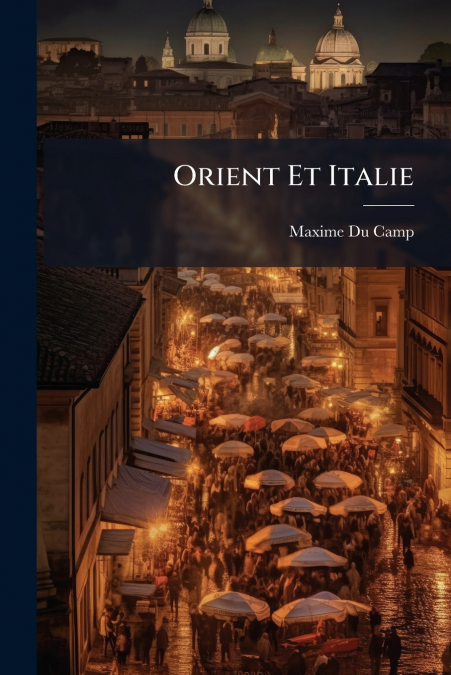
Orient et Italie: Souvenirs de Voyages et de Lectures by Maxime Du Camp offers a fascinating glimpse into the travel experiences and literary reflections of a 19th-century French author. This work captures Du Camp’s journeys through the Middle East and Italy, providing vivid descriptions and insightful observations of the cultures, landscapes, and historical sites he encountered. Du Camp, known for his association with Gustave Flaubert and his photographic documentation of historical sites, brings a unique perspective to his travel writing. In 'Orient et Italie,' readers are transported to exotic locales, experiencing the sights and sounds of a bygone era through the eyes of a perceptive traveler and cultured literary figure. The book provides valuable historical context and serves as a testament to the enduring allure of these regions, appealing to both history enthusiasts and lovers of classic French literature.This work has been selected by scholars as being culturally important, and is part of the knowledge base of civilization as we know it. This work was reproduced from the original artifact, and remains as true to the original work as possible. Therefore, you will see the original copyright references, library stamps (as most of these works have been housed in our most important libraries around the world), and other notations in the work.This work is in the public domain in the United States of America, and possibly other nations. Within the United States, you may freely copy and distribute this work, as no entity (individual or corporate) has a copyright on the body of the work.As a reproduction of a historical artifact, this work may contain missing or blurred pages, poor pictures, errant marks, etc. Scholars believe, and we concur, that this work is important enough to be preserved, reproduced, and made generally available to the public. We appreciate your support of the preservation process, and thank you for being an important part of keeping this knowledge alive and relevant.