 Librería Samer Atenea
 Kálamo Books
 Librería Elías (Asturias)
 Librería Kolima (Madrid)
 Librería Proteo (Málaga)
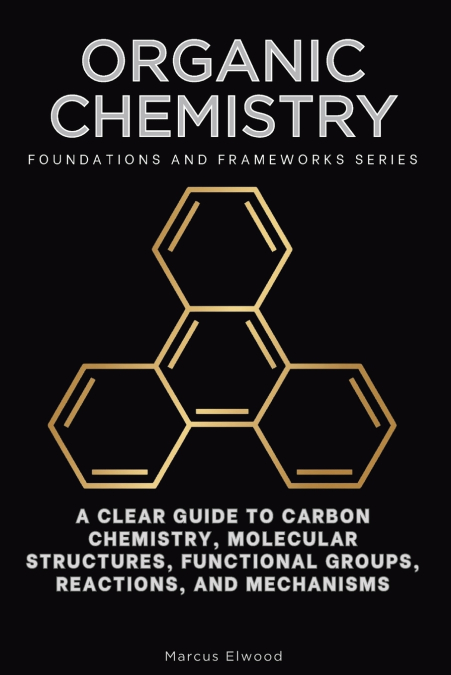
Organic chemistry makes sense once you see the patterns behind it. This book teaches you to read a structure, find where the electrons sit, and predict what a molecule will do before you memorize a single reaction. Nine chapters move in a set order: structure first, then reactivity, then real applications. Every reaction comes with the reason it happens, so when memory fails during an exam, the logic is still there for you to work from. The chapters cover: - Atoms, bonds, Lewis structures, VSEPR, resonance, and hybridization - Skeletal drawings, functional group families, and IUPAC naming - Newman projections, cyclohexane chairs, chirality, and R and S assignment using the Cahn-Ingold-Prelog rules, with the mirror-image forms of carvone that make spearmint and caraway smell different - Acids, bases, pKa, curved arrows, and energy diagrams - SN1, SN2, E1, and E2 mechanisms, with summary tables showing which conditions favor substitution and which favor elimination - Alkene and alkyne additions, from Markovnikov’s rule to hydroboration and ozonolysis - Diels-Alder, Hückel’s rule, and electrophilic aromatic substitution - Carbonyl compounds and amines, including Grignard reagents, acetals and imines, the Wittig reaction, nucleophilic acyl substitution, enolate chemistry with aldol, Claisen, and Michael reactions, and diazonium salts - Proton and carbon-13 NMR, IR, mass spectrometry, retrosynthesis, biomolecules, and polymers Each chapter closes with questions, and example responses sit at the back so you can check your reasoning after working each problem yourself. Tables collect comparable data, such as pKa values and reaction conditions, into review sheets you can use the night before a test. A glossary of terms, a historical timeline that starts with Friedrich Wöhler’s 1828 urea synthesis, and a list of recommended readings round out the book. This book works well for: - Students taking their first college organic course - Pre-med students preparing for the MCAT - Biology and pharmacy majors who need a firm base before biochemistry - Adults returning to the subject after years away - Self-taught learners who want the reasoning behind each step You need no prior organic background to start. A general chemistry course helps, and Chapter 1 reviews the Lewis structures and equilibrium ideas you will use throughout. By the last chapter, you will be able to: - Push curved arrows through reactions you have never seen - Identify an unknown compound from its spectra - Plan a multistep synthesis by working backward from the target The payoff reaches past the classroom. You will understand why sodium lauryl sulfate lifts grease from your hair, why old aspirin smells like vinegar, and why esomeprazole sits on the pharmacy shelf beside omeprazole. The subject stops being a list of facts to memorize and becomes a set of rules you can apply to any molecule you meet.