
Inicio > > Ciencias de la computación > Inteligencia artificial > Oppositional Concepts in Computational Intelligence
Oppositional Concepts in Computational Intelligence

Oppositional Concepts in Computational Intelligence


268,94 €
IVA incluido
Disponible
Editorial:
Springer Nature B.V.
Año de edición:
2010
Materia
Inteligencia artificial
ISBN:
9783642089787
268,94 €
IVA incluido
Disponible

Selecciona una librería:

  • Librería Samer Atenea
  • Librería Aciertas (Toledo)
  • Kálamo Books
  • Librería Perelló (Valencia)
  • Librería Elías (Asturias)
  • Donde los libros
  • Librería Kolima (Madrid)
  • Librería Proteo (Málaga)

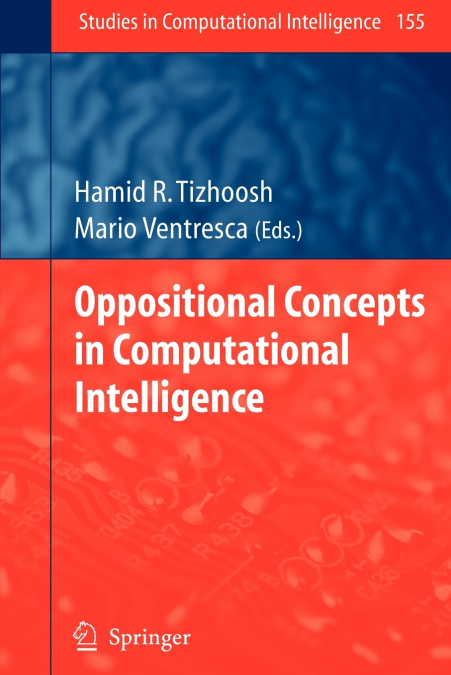
'Theoppositeofacorrectstatementisafalsestatement.Buttheopposite of a profound truth may well be another profound truth.' - Niels Bohr This volume is motivated in part by the observation that opposites permeate everything around us, in some form or another. Its study has attracted the attention of countless minds for at least 2500 years. However, due to the lack of an accepted mathematical formalism for opposition it has not been explicitly studiedtoanygreatlengthin?eldsoutsideofphilosophyandlogic.This,despite the fact that we observe opposition everywhere in nature, our minds seem to divide the world into entities and opposite entities; indeed we use opposition everyday. We have become so accustomed to opposition that its existence is accepted, not usually questioned and its importance is constantly overlooked. On one hand, this volume is a ?st attempt to bring together researchers who are inquiring into the complementary nature of systems and processes and, on the other hand, provide some elementary components for a framework to establish a formalism for opposition-based computing. From a computational intelligence perspective, many successful opposition-based concepts have been in existence for a long time. It is not our intention to recast these existing methods, rather to elucidate that, while diverse, they all share the commonality of opposition - in one form or another, either implicitly or explicitly. To this end, we have attempted to provide rough guidelines to understand what makes concepts 'oppositional'.
Artículos relacionados

  • Artificial Cognition Systems
    ...
  • Cross-Disciplinary Applications of Artificial Intelligence and Pattern Recognition
    Vijay Kumar Mago
    The need for intelligent machines in areas such as medical diagnostics, biometric security systems, and image processing motivates researchers to develop and explore new techniques, algorithms, and applications in this evolving field. Cross-Disciplinary Applications of Artificial Intelligence and Pattern Recognition: Advancing Technologies provides a common platform for researc...
  • Emerging Applications of Natural Language Processing
    Over the last few years, the area of Natural Language Processing has drastically grown in recognition, not only within the research and development community, but also with industry professionals. As NLP continues to be discussed and researched, certain areas continue to grow and mature. As a result, the need for advanced research and information is in high demand. Emerging App...
  • Androids, Cyborgs, and Robots in Contemporary Culture and Society
    Steven John Thompson
    Mankind’s dependence on artificial intelligence and robotics is increasing rapidly as technology becomes more advanced. Finding a way to seamlessly intertwine these two worlds will help boost productivity in society and aid in a variety of ways in modern civilization. Androids, Cyborgs, and Robots in Contemporary Culture and Society is an essential scholarly resource that delve...
  • Deep Learning Innovations and Their Convergence With Big Data
    The expansion of digital data has transformed various sectors of business such as healthcare, industrial manufacturing, and transportation. A new way of solving business problems has emerged through the use of machine learning techniques in conjunction with big data analytics. Deep Learning Innovations and Their Convergence With Big Data is a pivotal reference for the latest sc...
  • Computational Psychoanalysis and Formal Bi-Logic Frameworks
    Giuseppe Iurato
    Computational psychoanalysis is a new field stemming from Freudian psychoanalysis. The new area aims to understand the primary formal structures and running mechanisms of the unconscious while implementing them into computer sciences. Computational Psychoanalysis and Formal Bi-Logic Frameworks provides emerging information on this new field which uses psychoanalysis and the unc...