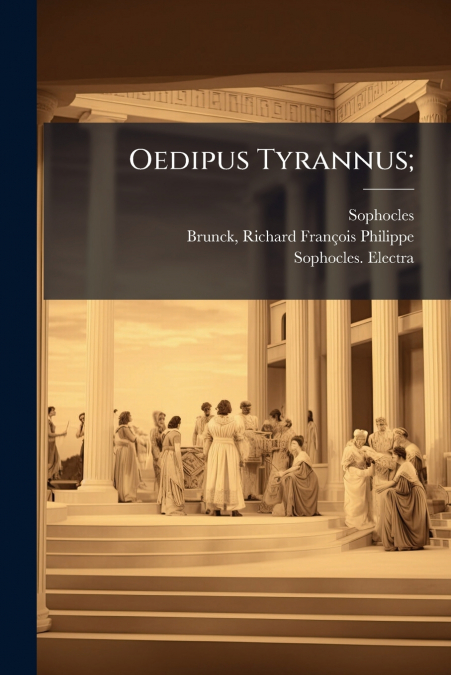
Sophocles / Sophocles. Electra / Richard François Philippe 1729 Brunck
 Librería Samer Atenea
 Kálamo Books
 Librería Elías (Asturias)
 Librería Kolima (Madrid)
 Librería Proteo (Málaga)
Oedipus Tyrannus, a cornerstone of Greek tragedy, stands as a testament to Sophocles’ enduring genius. This edition presents the original Greek text, offering readers direct engagement with the power and beauty of Sophocles’ language. The play explores profound themes of fate, free will, and the burden of knowledge. Oedipus, the king who unknowingly fulfills a terrible prophecy, grapples with the horrifying truth of his own life. His relentless pursuit of justice leads him to a devastating self-discovery, forcing him to confront the darkest aspects of human existence. This edition, likely published around 1819, invites scholars and enthusiasts to delve into the nuances of Sophoclean drama, experiencing the raw emotion and intellectual rigor that have captivated audiences for centuries. Along with ’Electra’, this volume represents a key work in the canon of classical Greek literature. The insightful work of Richard François Philippe Brunck further enhances its historical and literary value.This work has been selected by scholars as being culturally important, and is part of the knowledge base of civilization as we know it. This work was reproduced from the original artifact, and remains as true to the original work as possible. Therefore, you will see the original copyright references, library stamps (as most of these works have been housed in our most important libraries around the world), and other notations in the work.This work is in the public domain in the United States of America, and possibly other nations. Within the United States, you may freely copy and distribute this work, as no entity (individual or corporate) has a copyright on the body of the work.As a reproduction of a historical artifact, this work may contain missing or blurred pages, poor pictures, errant marks, etc. Scholars believe, and we concur, that this work is important enough to be preserved, reproduced, and made generally available to the public. We appreciate your support of the preservation process, and thank you for being an important part of keeping this knowledge alive and relevant.