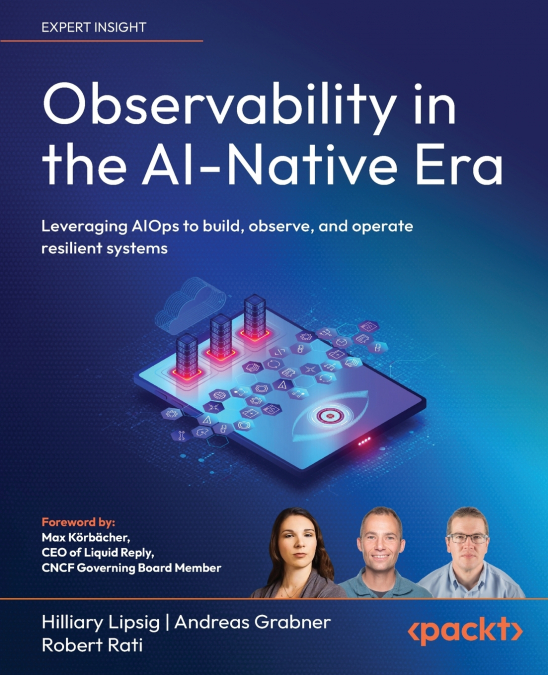
Andreas Grabner / Hilliary Lipsig / Robert Rati
 Librería Samer Atenea
 Kálamo Books
 Librería Elías (Asturias)
 Librería Kolima (Madrid)
 Librería Proteo (Málaga)
Discover how AIOps is transforming the observability landscape for cloud-native and traditional systems. Learn how to build, monitor, and operate resilient services using AI-drive dynamic insights for smarter and more scalable operationsKey Features:- Bridges observability and AI into a unified operational approach rather than treating them as separate domains- Uses a continuous case study to connect concepts across chapters and reflect real-world engineering scenarios- Focuses on evolving operational maturity from reactive to proactive and preventive systems- Purchase of the print or Kindle book includes a free PDF eBookBook Description:Observability is mandatory for building and operating cloud-native distributed systems. Tools like OpenTelemetry have standardized how observability data is sourced, and AI now transforms how we extract value from the vast amounts of observability data generated by modern systems. This book guides you in implementing scalable observability, improving engineering efficiency with AI, and integrating observability throughout the Software Development Lifecycle (SDLC) via modern self-service internal developer platforms.You’ll start with observability basics and learn how AIOps enhances signal correlation, anomaly detection, and root-cause analysis. Using real-world examples, the book demonstrates how to implement AIOps, build proactive detection pipelines, and automate diagnostics and remediation. You’ll explore best practices for expanding observability using OpenTelemetry, Prometheus, Grafana, Dynatrace, Datadog, and New Relic alongside machine learning models, ensuring your systems are accurate, efficient, and secure.You’ll also learn how to benchmark, measure, and secure your AIOps implementation, and gain a practical understanding of software compliance and how it applies to your systems. By the end of this book, you’ll be ready to design and deliver AIOps-enabled observability solutions that make cloud-native systems more resilient, efficient, and secure.What You Will Learn:- Build observability pipelines for logs, metrics, traces and events- Implement standards such as OpenTelemetry and Prometheus- Correlate signals from multiple sources for better incident triage- Apply AI/ML for anomaly detection and root cause analysis- Design scalable architectures for intelligent monitoring- Automate resiliency through self-healing and remediation agentsWho this book is for:This book is for Software engineers and engineering leaders working on teams with operational responsibilities, such as platform engineering, site reliability engineering (SRE), DevOps, or application development, who want to integrate AIOps capabilities into their workflows will benefit from this book. If your team is responsible for building and running high-performing, resilient software systems, this book is for you.Table of Contents- Observability: The Art of Turning Data into Insights- The Elephant in the Room: Artificial Intelligence- From Observability to AIOps and the Use Cases it Solves Today- ACME Financial Services: Implementing AIOps- Democratizing Observability: A Primer to Self-Service Platforms- The Observability Agent: Real-Life Use Cases- ACME Financial Services: How to Move from AIOps to Agentic Platforms- Evolving Operations: Proactive > Preventive > Self-Driven Architecture- No Future Without Challenges- ACME Financial Services: How Will the AI Future Shape Our Company?