
Inicio > Tecnología, ingeniería, agricultura > > Química industrial > Non-Oxide Technical and Engineering Ceramics
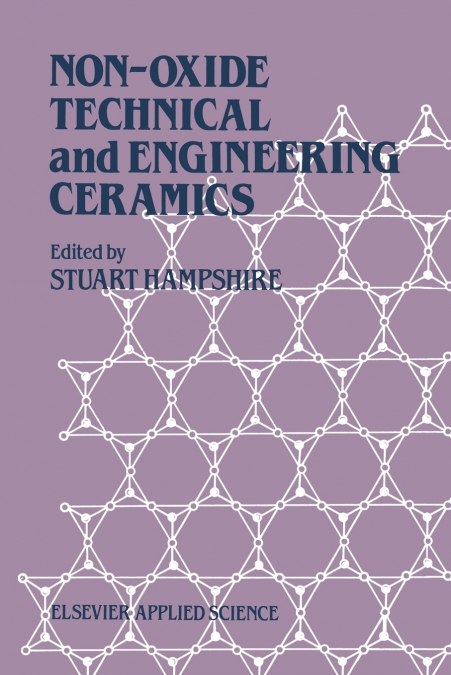
Non-Oxide Technical and Engineering Ceramics

Non-Oxide Technical and Engineering Ceramics

S. Hampshire

133,04 €
IVA incluido
Disponible
Editorial:
Springer Nature B.V.
Año de edición:
2011
Materia
Química industrial
ISBN:
9789401080316
133,04 €
IVA incluido
Disponible

Selecciona una librería:

  • Librería Samer Atenea
  • Librería Aciertas (Toledo)
  • Kálamo Books
  • Librería Perelló (Valencia)
  • Librería Elías (Asturias)
  • Donde los libros
  • Librería Kolima (Madrid)
  • Librería Proteo (Málaga)

Conferences on technical and engineering ceramics are held with increasing frequency, having become fashionable because the potential of ceramics in profitable growth industries is an urgent matter of considerable debate and discussion. Japanese predictions are that the market value of ceramics will grow 10 at about 10% per annum to reach at least $10 by the end of the century. Seventy per cent of this market will be in electroceramics, applications for which include insulating substrates in integrated circuits, ferroelectric capacitors, piezoelectric oscillators and transdu­ cers, ferrite magnets, and ion-conducting solid electrolytes and sen­ sors. All these are oxides, and so are excluded by the title of the Limerick Conference. Why ’Non-oxide’? The other major ceramics potential is in struc­ tural engineering components and engine applications. Here, the greatest impetus to research and development has been the attempt to produce a ceramic gas turbine. Heat engines become more efficient as their working temperature increases, but nickel-base superalloy en­ gines have about reached their limit. Compared with metals, ceramics have higher strengths at high temperatures, better oxidation and corrosion resistance, and are also less dense. In general, ceramics have better properties above about 1000°C except in one respect-their inherent brittleness. The work of fracture is therefore much smaller than for metals and so the permitted flaw size is also smaller.

Artículos relacionados

  • Quantitative Structure-Activity Relationships in Drug Design, Predictive Toxicology, and Risk Assessment
    Kunal Roy
    Quantitative structure-activity relationships (QSARs) represent predictive models derived from the application of statistical tools correlating biological activity or other properties of chemicals with descriptors representative of molecular structure and/or property. Quantitative Structure-Activity Relationships in Drug Design, Predictive Toxicology, and Risk Assessment discus...
  • Chemical Compound Structures and the Higher Dimension of Molecules
    Gennadiy Vladimirovich Zhizhin
    Originally, scientists believed that molecules were three-dimensional; however, studies have proven that geometric dimensions are continuous. Therefore, molecules are able to have higher dimensions which influences how they interact with other molecules leading to advances in various fields including nanomedicine, nanotoxicology and quantum biology. Chemical Compound Structures...
  • CHEMICAL THERMODYNAMICS, 2ND EDITION
    Byung Chan Eu / BYUNG CHAN EU & MAZEN AL-GHOUL / EU BYUNG CHAN / Mazen Al-Ghoul
    This book enables the reader to learn, in a single volume, equilibrium and nonequilibrium thermodynamics as well as generalized forms of hydrodynamics for linear and nonlinear processes applied to various hydrodynamic flow processes — including chemical oscillation phenomena and pattern formations, shock wave phenomena, sound wave propagations, and Liesegang pattern formation, ...
  • CARBOHYDRATE CHEMISTRY
    ALEN RAIMO / Raimo Alen
     This book presents a comprehensive approach to the versatile and fascinating field of carbohydrate chemistry. It covers, besides the colorful historical perspective within the utilization of carbohydrates and their derivatives, all modern aspects on their properties, nomenclature, uses, and natural occurrence as such or as residues in a variety of biologically active molecules...
  • Recent Developments in Geopolymers and Alkali-Activated Materials
    Sujeong Lee
    We are compiling and publishing a collection of the latest research papers in the fields of Geopolymer and Alkali-Activated Materials (AAM). This compilation includes eight original research and two review papers covering a diverse range of topics, including various raw materials, manufacturing processes, and applications in the realms of Geopolymer and AAM. The publication aim...
  • Introduction to Chemical Engineering Fluid Mechanics
    William M. Deen
    ...