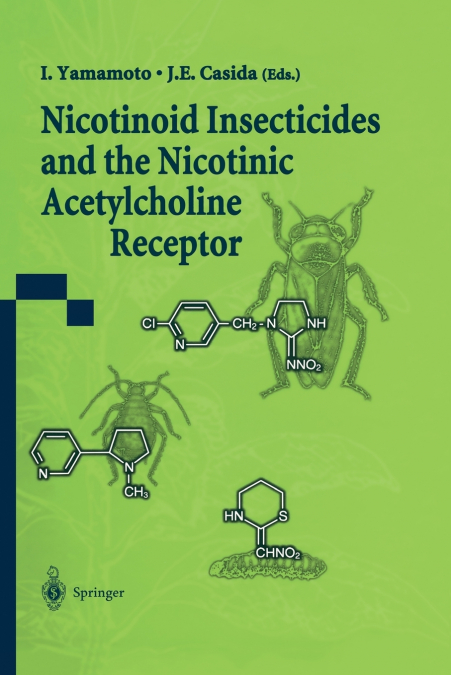

Nicotinoid Insecticides and the Nicotinic Acetylcholine Receptor

Nicotinoid Insecticides and the Nicotinic Acetylcholine Receptor


271,59 €
IVA incluido
Disponible
Editorial:
Springer Nature B.V.
Año de edición:
2013
Materia
Agronomía y producción agrícola
ISBN:
9784431680116
271,59 €
IVA incluido
Disponible

Selecciona una librería:

  • Librería Samer Atenea
  • Librería Aciertas (Toledo)
  • Kálamo Books
  • Librería Perelló (Valencia)
  • Librería Elías (Asturias)
  • Donde los libros
  • Librería Kolima (Madrid)
  • Librería Proteo (Málaga)

Insect pest control has continuously evolved from inorganics to botanicals, to chlo­ rinated hydrocarbons, to organophosphorus compounds and methylcarbamates, then synthetic pyrethroids and most recently synthetic nicotinoids as the major classes. These insecticides allowed high standards of crop protection at minimal cost. A limitation in each new class of compounds is the selection of resistant strains and ultimate control failures and this serves as a driving force to discover and develop replacement compounds to circumvent resistance and overcome problem areas. The nicotinoids now play a critical role in meeting this need. Three generations of chemicals are involved in the history of nicotinoid insecti­ cides. The first generation was the botanical nicotine used for at least three centuries to control sucking insect pests but largely replaced in the 1940s and 1950s by the more effective organophosphorus compounds and methylcarbamates, some with systemic properties. Synthesis programs based on nicotine as a prototype did not yield compounds that could compete with other synthetic insecticides. The second generation was the nitromethylene type such as nithiazine, discovered by Shell sci­ entists in a screening/optimization program. The nitromethylenes had the potency, selectivity, and systemic properties but lacked the field effectiveness largely because of photolability (so close yet so far from a major commercial product). The third generation required a series of advances made by Bayer researchers starting from nithiazine as the model and enhancing its photostability and potency with a nitroimine and chloropyridyl moiety, respectively, to give imidacloprid, the subject of much of this monograph.
Artículos relacionados

  • Recherches sur les instruments aratoires et le travail du sol en Gaule Belgique
    André Marbach
    A volume of detailed research and summary into metal farming tools used in Gaul/Upper Germania from the Gallo-Romano period; indeed many of the types are still in use today. 199 finds are investigated and reconstructed to show the various techniques of manufacture, use and efficiency. The new method of analysis has shown that ploughing equipment was capable of turning the soil ...
    Disponible

    109,47 €

  • Instant Insights
    Bryan G Hopkins / Dan S Long / Dr Dan S. Long / Dr Paul Miller / Prof Bryan G. Hopkins
    This book provides a detailed overview of the history, current status and future needs of fertiliser developments in an era where sustainability is of paramount importance. Chapters also review recent advances in the use of fertiliser technologies, such as crop sprayers. ...
    Disponible

    69,64 €

  • Instant Insights
    Dr Roland Pieruschka / Dr Sherif Hamdy / Prof Ulrich Schurr / Thomas Vatter
    This book reviews recent advances in the application of phenotyping techniques to optimise crop breeding programmes. Chapters discuss the use of phenotyping as a means of improving crop yield, boosting genetic gain and identifying desirable traits in crop roots. ...
    Disponible

    69,69 €

  • FOOD SECURITY ISSUES IN ASIA
    Paul Teng / TENG PAUL
    Asia is not only the largest producer of important food items like rice and vegetable oil, but also the largest importer of commodities like soybeans and corn. Additionally, more than half the world’s population lives in Asia and thus the largest number of food insecure people are also in Asia. Food security is therefore a matter of paramount importance in Asia.This is the only...
  • Developing circular agricultural production systems
    Barbara Amon
    This collection summarises the wealth of research on the ways of achieving circular agricultural production systems through using minimal inputs, closing nutrient loops, reducing emissions and reusing and valorising agricultural wastes. ...
  • Improving nitrogen use efficiency in crop production
    Professor Cl Wagner-Riddle
    This collection reviews the wealth of research on ways of improving nitrogen use efficiency in crop production as a means of reducing the agricultural sector’s environmental impact and rebalancing the global nitrogen cycle. ...