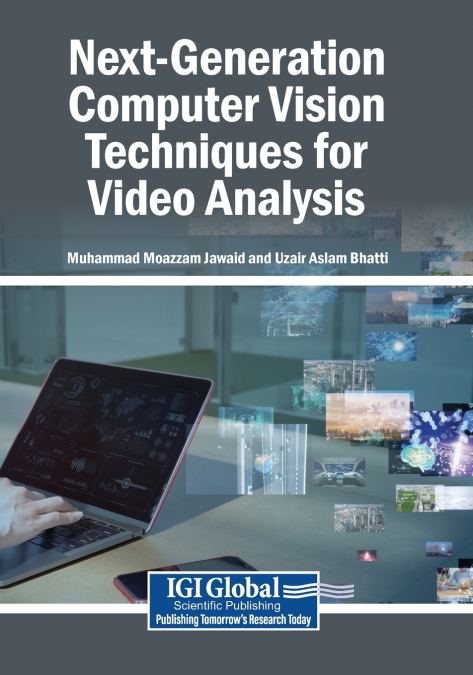

Inicio > > Ciencias de la computación > Inteligencia artificial > Next-Generation Computer Vision Techniques for Video Analysis
Next-Generation Computer Vision Techniques for Video Analysis

Next-Generation Computer Vision Techniques for Video Analysis


316,04 €
IVA incluido
Disponible
Editorial:
IGI Global
Año de edición:
2026
Materia
Inteligencia artificial
ISBN:
9798260009666
316,04 €
IVA incluido
Disponible

Selecciona una librería:

  • Librería Samer Atenea

  • Kálamo Books
  • Librería Elías (Asturias)
  • Librería Kolima (Madrid)
  • Librería Proteo (Málaga)

Cameras, connected devices, and sensor networks have multiplied fast, and the sheer volume of video data they generate has outgrown what traditional monitoring methods can handle. Simply detecting objects in a frame is not enough anymore. Recent advances in computer vision are pushing systems toward something closer to genuine understanding, recognizing activities, tracking events, and interpreting how people and objects interact within complex, changing environments. That shift is what is enabling a new generation of video analytics, ones that can maintain real situational awareness rather than just flag movement. The applications are already spreading fast, from security and transportation to healthcare, industry, and smart city environments, all relying on systems that can make sense of visual data in real time. Next-Generation Computer Vision Techniques for Video Analysis bridges the gap between theoretical deep learning architectures and their practical application in high-stakes environments, synthesizing fragmented research on temporal modeling to move beyond frame-by-frame analysis toward holistic video understanding. By connecting real-world challenges with a framework for ethical AI deployment, this book equips readers to build privacy-preserving video analytics systems that address bias mitigation in automated surveillance. Covering topics such as activity recognition, video segmentation, and vision language models, this book is an indispensable academic resource for graduate and doctoral students, computer vision researchers, security and surveillance system developers, smart city engineers, industrial automation engineers, policymakers, and more.
Artículos relacionados

  • Artificial Cognition Systems
    ...
  • Cross-Disciplinary Applications of Artificial Intelligence and Pattern Recognition
    Vijay Kumar Mago
    The need for intelligent machines in areas such as medical diagnostics, biometric security systems, and image processing motivates researchers to develop and explore new techniques, algorithms, and applications in this evolving field. Cross-Disciplinary Applications of Artificial Intelligence and Pattern Recognition: Advancing Technologies provides a common platform for researc...
  • Emerging Applications of Natural Language Processing
    Over the last few years, the area of Natural Language Processing has drastically grown in recognition, not only within the research and development community, but also with industry professionals. As NLP continues to be discussed and researched, certain areas continue to grow and mature. As a result, the need for advanced research and information is in high demand. Emerging App...
  • Androids, Cyborgs, and Robots in Contemporary Culture and Society
    Steven John Thompson
    Mankind’s dependence on artificial intelligence and robotics is increasing rapidly as technology becomes more advanced. Finding a way to seamlessly intertwine these two worlds will help boost productivity in society and aid in a variety of ways in modern civilization. Androids, Cyborgs, and Robots in Contemporary Culture and Society is an essential scholarly resource that delve...
  • Deep Learning Innovations and Their Convergence With Big Data
    The expansion of digital data has transformed various sectors of business such as healthcare, industrial manufacturing, and transportation. A new way of solving business problems has emerged through the use of machine learning techniques in conjunction with big data analytics. Deep Learning Innovations and Their Convergence With Big Data is a pivotal reference for the latest sc...
  • Computational Psychoanalysis and Formal Bi-Logic Frameworks
    Giuseppe Iurato
    Computational psychoanalysis is a new field stemming from Freudian psychoanalysis. The new area aims to understand the primary formal structures and running mechanisms of the unconscious while implementing them into computer sciences. Computational Psychoanalysis and Formal Bi-Logic Frameworks provides emerging information on this new field which uses psychoanalysis and the unc...