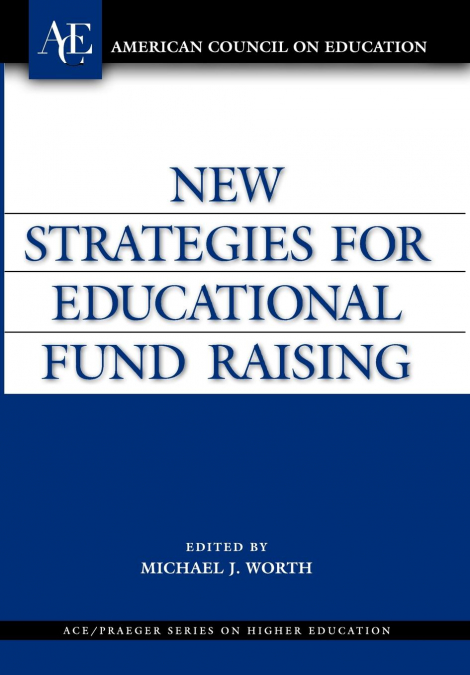

New Strategies for Educational Fund Raising

New Strategies for Educational Fund Raising


124,22 €
IVA incluido
Consulta disponibilidad
Editorial:
Bloomsbury Publishing plc
Año de edición:
2002
Materia
Organización y gestión educativa
ISBN:
9781573565189

Selecciona una librería:

  • Librería Samer Atenea
  • Librería Aciertas (Toledo)
  • Kálamo Books
  • Librería Perelló (Valencia)
  • Librería Elías (Asturias)
  • Donde los libros
  • Librería Kolima (Madrid)
  • Librería Proteo (Málaga)

In this sequel to the highly respected and practical 1993 book on fund raising, Worth and his group of authoritative contributors cover areas that did not even exist in this field in 1993, including the concepts of 'principal gifts' and 'benchmarking.' They adapt strategies from Worth’s earlier book and introduce many new ones to meet current challenges and take advantage of new opportunities. Comprising 31 chapters divided into ten logical parts, the authors provide a complete picture of this field, which is so important to leaders in higher education. Beginning with a strong base of knowledge, the authors then discuss topics ranging from raising funds from individuals; creating the campaign (accounting, long-range planning, leadership, the mission, kickoff); corporate and foundation support; traditions of giving; managing and supporting development programs; ethical concerns; and trends for the future.Michael Worth gives a great deal of attention to the environment in which those responsible for advancement in higher education have to work today. The book addresses new areas in the field that didn’t exist when Worth wrote his first edition of this book in 1993. For example, the use of financial instruments in the planning of gift giving are more sophisticated, and business techniques have been tapped to improve management of programs and measurement of success. Part II of the book describes the underlying foundations of educational fund raising in three chapters, each written by an expert contributor. This section of the book describes the base of knowledge in the field (theory and research) and discusses the institutional plan and its relationship to the goals and objectives of the institution. Part V, covers corporate and foundation support, which is based on reasoned strategies and business plans and goals rather than on altruism and emotion, which can often be the foundation for individual giving. The book also includes a glossary and a selective bibliography.

Artículos relacionados

  • Walking the Law and History
    Michelle Janene
    The companion student workbook for the Bible curriculum of Walking the Law and History Genesis. Students will participate in deep Bible study of the creation of the world, the foundations of the Christian faith, and the formation of the Jewish nation.  ...
    Disponible

    9,81 €

  • Reforming Education for the Real World
    George P Waldheim
    Education, as we know it in America, is too often characterized as living in a world by itself; unaccountable and unimproved--so different from the Real World.  Year after year 'Band-Aid' attempts are initiated to improve education and again, year after year, those attempts only produce marginal improvement--if any.  Thus, our international ranking is still depicted as 'mediocr...
    Disponible

    12,21 €

  • Let’s Talk Sex & STDs
    Dr. Katina Davis-Kennedy / DrKatina Davis-Kennedy
    There comes a time when every person has to learn about sex; typically, students learn within their middle school years about sex education. Unfortunately, by then they have been influenced by others with the wrong information, or have heard rumors that are mostly untrue. Let's Talk Sex and STDs: The Student Edition is here to lay all of the misleading information and stori...
    Disponible

    25,31 €

  • Learning with Mobile Technologies, Handheld Devices, and Smart Phones
    Mobile Learning is a new trend in pedagogical communities. It matches the speed of fast moving methodologies in pedagogical world. The theories of activity-based learning, problem-based learning, work-based learning, and opinion-based learning, learner-centered learning, and so forth, can be integrated with these tiny handheld devices. Students and teachers communicate effectiv...
  • Cultural Awareness and Competency Development in Higher Education
    As the world becomes more globalized, student populations in university settings will continue to grow in diversity. To ensure students develop the cultural competence to adapt to new environments, universities and colleges must develop policies and programs to aid in the progression of cultural acceptance and understanding. Cultural Awareness and Competency Development in High...
  • Advancing Next-Generation Teacher Education through Digital Tools and Applications
    The implementation of the Common Core State Standards program has spearheaded many changes within the education field. As this initiative is ultimately designed to optimize student performance and success, it is critical that teacher education programs and technological tools being utilized in classrooms align with Common Core State Standards. Advancing Next-Generation Teacher ...