
Inicio > Economía, finanzas, empresa y gestión > Economía > Economía internacional > New Institutional Arrangements for the World Economy
New Institutional Arrangements for the World Economy

New Institutional Arrangements for the World Economy

Hans-Jürgen Vosgerau

132,94 €
IVA incluido
Disponible
Editorial:
Springer Nature B.V.
Año de edición:
2011
Materia
Economía internacional
ISBN:
9783642836497
132,94 €
IVA incluido
Disponible

Selecciona una librería:

  • Librería Samer Atenea
  • Librería Aciertas (Toledo)
  • Kálamo Books
  • Librería Perelló (Valencia)
  • Librería Elías (Asturias)
  • Donde los libros
  • Librería Kolima (Madrid)
  • Librería Proteo (Málaga)

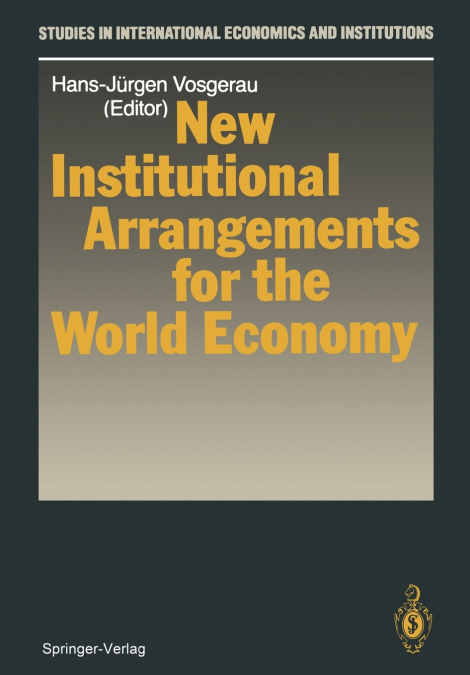
New Institutional Arrangements for the World Economy Hans-Jiirgen Vosgerau, Konstanz I. The Problem During the first days of July 1987 the newly established Sonderforschungs­ bereich 178 'Internationalisierung der Wirtschaft' held its first symposium in Konstanz/Bodensee. 'New Institutional Arrangements for the World Economy' were discussed by a group of economists and lawyers working in the fields of interna­ tional trade, international monetary economics, international finance, international public choice, and international economic law. Cooperation between these areas of research is an important condition for attaining the long-term aim of the Sonderforschungsbereich, viz. analysis of the complex interdependencies between international economic transactions of various kinds and international economy­ related institutions in a broad sense. The nature of these interdependencies seems to be crucial for the world economy’s further development. A better understanding of their characteristics will be helpful for the solution of most imminent international economic problems. Four problem areas were especially addressed during the conference, each con­ sisting of three or four contributions. The revised papers are presented in this volume, each followed by a comment of the invited discussant, or by a summary of the discussion. The last contribution is meant as a summary conclusion and has no comment. The four problem areas discussed were: (1) Exchange rate stabilization and econ­ omic policy coordination, (2) International financial markets and their regulation, (3) Protectionism and the Uruguay GAIT-round, and (4) The institutional frame­ work for international production.

Artículos relacionados

  • Regional Economic Integration and the Global Financial System
    Engin Sorhun / Hasan Dinçer / Unit Hacioglu
    In theory, regionalism and globalization are intended to be viewed as two separate concepts. However, as long as the approaches complement each other, considering these paradigms in tandem can have significantly positive effects on the overall status of the world economy. Regional Economic Integration and the Global Financial System addresses recent trends in regional integrati...
  • Handbook of Research on Impacts of International Business and Political Affairs on the Global Economy
    The growth of global commerce depends on many different factors and strategies in order for multinational corporations to efficiently compete and thrive in the international marketplace. In addition to business strategies, corporations must also be aware of political affairs that may impact their global economic status. The Handbook of Research on Impacts of International Busin...
  • NEXT CONVERGENCE
    MICHAEL SPENCE
    ...
    Disponible

    17,21 €

  • Interest and Prices
    Michael Woodford
    With the collapse of the Bretton Woods system, any pretense of a connection of the world’s currencies to any real commodity has been abandoned. Yet since the 1980s, most central banks have abandoned money-growth targets as practical guidelines for monetary policy as well. How then can pure 'fiat' currencies be managed so as to create confidence in the stability of national unit...
  • War, Wine, and Taxes
    John V.C. Nye
    In War, Wine, and Taxes, John Nye debunks the myth that Britain was a free-trade nation during and after the industrial revolution, by revealing how the British used tariffs-notably on French wine-as a mercantilist tool to politically weaken France and to respond to pressure from local brewers and others. The book reveals that Britain did not transform smoothly from a mercantil...
  • The Social Construction of Free Trade
    Francesco Duina
    This book offers a compelling new interpretation of the proliferation of regional trade agreements (RTAs) at the end of the twentieth century. Challenging the widespread assumption that RTAs should be seen as fundamentally similar economic initiatives to pursue free trade, Francesco Duina proposes that the world is reorganizing itself into regions that are highly distinctive an...
    Disponible

    54,25 €

Otros libros del autor