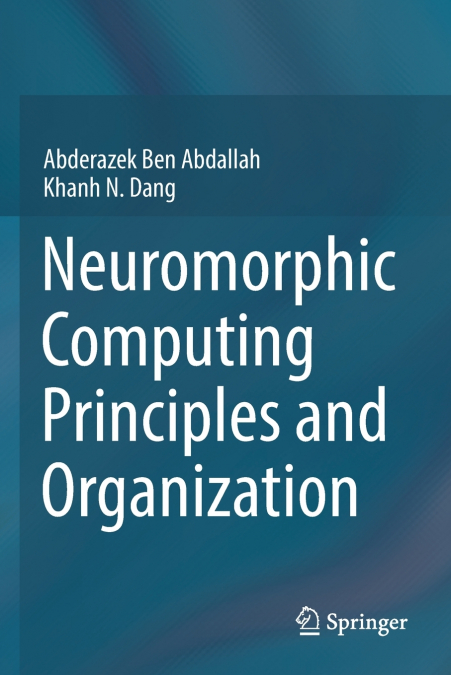
Abderazek Ben Abdallah / Khanh N. Dang
 Librería Samer Atenea
 Kálamo Books
 Librería Elías (Asturias)
 Librería Kolima (Madrid)
 Librería Proteo (Málaga)
This book focuses on neuromorphic computing principles and organization and how to build fault-tolerant scalable hardware for large and medium scale spiking neural networks with learning capabilities. In addition, the book describes in a comprehensive way the organization and how to design a spike-based neuromorphic system to perform network of spiking neurons communication, computing, and adaptive learning for emerging AI applications. The book begins with an overview of neuromorphic computing systems and explores the fundamental concepts of artificial neural networks. Next, we discuss artificial neurons and how they have evolved in their representation of biological neuronal dynamics. Afterward, we discuss implementing these neural networks in neuron models, storage technologies, inter-neuron communication networks, learning, and various design approaches. Then, comes the fundamental design principle to build an efficient neuromorphic system in hardware. The challenges that need to be solved toward building a spiking neural network architecture with many synapses are discussed. Learning in neuromorphic computing systems and the major emerging memory technologies that promise neuromorphic computing are then given.A particular chapter of this book is dedicated to the circuits and architectures used for communication in neuromorphic systems. In particular, the Network-on-Chip fabric is introduced for receiving and transmitting spikes following the Address Event Representation (AER) protocol and the memory accessing method. In addition, the interconnect design principle is covered to help understand the overall concept of on-chip and off-chip communication. Advanced on-chip interconnect technologies, including si-photonic three-dimensional interconnects and fault-tolerant routing algorithms, are also given. The book also covers the main threats of reliability and discusses several recovery methods for multicore neuromorphic systems. This is important for reliable processing in several embedded neuromorphic applications. A reconfigurable design approach that supports multiple target applications via dynamic reconfigurability, network topology independence, and network expandability is also described in the subsequent chapters. The book ends with a case study about a real hardware-software design of a reliable three-dimensional digital neuromorphic processor geared explicitly toward the 3D-ICs biological brain’s three-dimensional structure. The platform enables high integration density and slight spike delay of spiking networks and features a scalable design. We present methods for fault detection and recovery in a neuromorphic system as well.Neuromorphic Computing Principles and Organization is an excellent resource for researchers, scientists, graduate students, and hardware-software engineers dealing with the ever-increasing demands on fault-tolerance, scalability, and low power consumption. It is also an excellent resource for teaching advanced undergraduate and graduate students about the fundamentals concepts, organization, and actual hardware-software design of reliable neuromorphic systems with learning and fault-tolerance capabilities.