 Librería Samer Atenea
 Kálamo Books
 Librería Elías (Asturias)
 Librería Kolima (Madrid)
 Librería Proteo (Málaga)
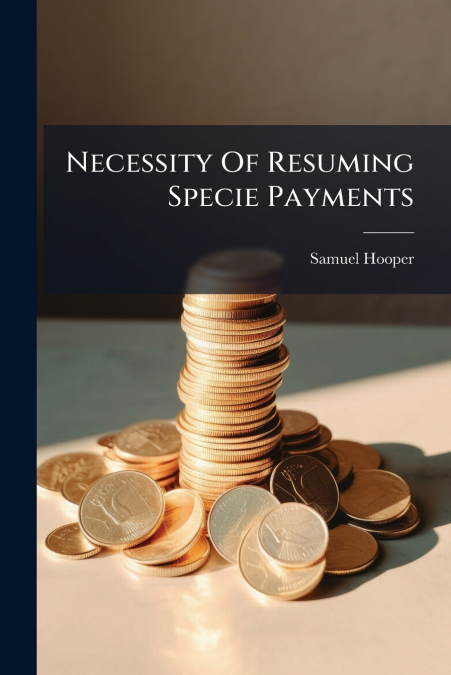
In 'Necessity Of Resuming Specie Payments,' Hon. Samuel Hooper of Massachusetts delivers a compelling speech before the House of Representatives on February 5, 1869, addressing a critical issue of the post-Civil War era. Hooper’s speech delves into the imperative of reinstating specie payments-the redemption of paper money in gold or silver-to stabilize the nation’s economy. Hooper, a prominent figure in financial circles and a member of Congress, brings his expertise to bear as he articulates the benefits and necessities of returning to a metallic standard. His arguments provide insight into the economic debates of the time and the challenges faced by policymakers in shaping the nation’s financial future. This historical document offers readers a valuable glimpse into the economic policies and legislative deliberations of the 19th century United States. It remains relevant for those studying economic history, monetary policy, and the political landscape of the Reconstruction era.This work has been selected by scholars as being culturally important, and is part of the knowledge base of civilization as we know it. This work was reproduced from the original artifact, and remains as true to the original work as possible. Therefore, you will see the original copyright references, library stamps (as most of these works have been housed in our most important libraries around the world), and other notations in the work.This work is in the public domain in the United States of America, and possibly other nations. Within the United States, you may freely copy and distribute this work, as no entity (individual or corporate) has a copyright on the body of the work.As a reproduction of a historical artifact, this work may contain missing or blurred pages, poor pictures, errant marks, etc. Scholars believe, and we concur, that this work is important enough to be preserved, reproduced, and made generally available to the public. We appreciate your support of the preservation process, and thank you for being an important part of keeping this knowledge alive and relevant.