 Librería Samer Atenea
 Kálamo Books
 Librería Elías (Asturias)
 Librería Kolima (Madrid)
 Librería Proteo (Málaga)
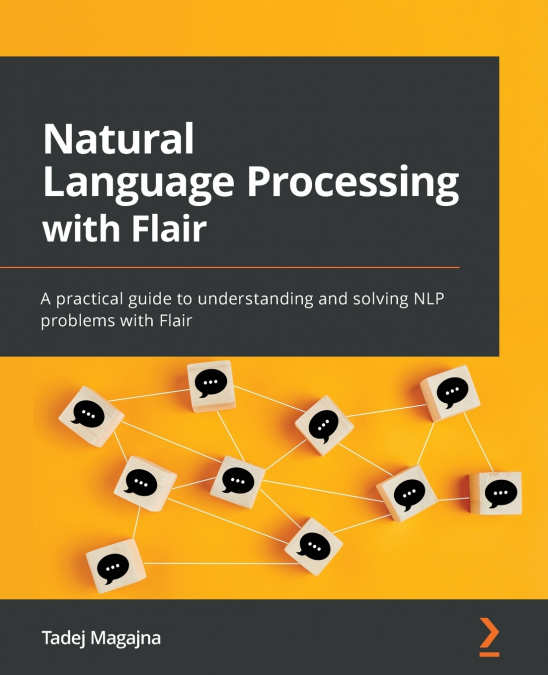
Learn how to solve practical NLP problems with the Flair Python framework, train sequence labeling models, work with text classifiers and word embeddings, and much more through hands-on practical exercisesKey Features:Backed by the community and written by an NLP expertGet an understanding of basic NLP problems and terminologySolve real-world NLP problems with Flair with the help of practical hands-on exercisesBook Description:Flair is an easy-to-understand natural language processing (NLP) framework designed to facilitate training and distribution of state-of-the-art NLP models for named entity recognition, part-of-speech tagging, and text classification. Flair is also a text embedding library for combining different types of embeddings, such as document embeddings, Transformer embeddings, and the proposed Flair embeddings.Natural Language Processing with Flair takes a hands-on approach to explaining and solving real-world NLP problems. You’ll begin by installing Flair and learning about the basic NLP concepts and terminology. You will explore Flair’s extensive features, such as sequence tagging, text classification, and word embeddings, through practical exercises. As you advance, you will train your own sequence labeling and text classification models and learn how to use hyperparameter tuning in order to choose the right training parameters. You will learn about the idea behind one-shot and few-shot learning through a novel text classification technique TARS. Finally, you will solve several real-world NLP problems through hands-on exercises, as well as learn how to deploy Flair models to production.By the end of this Flair book, you’ll have developed a thorough understanding of typical NLP problems and you’ll be able to solve them with Flair.What You Will Learn:Gain an understanding of core NLP terminology and conceptsGet to grips with the capabilities of the Flair NLP frameworkFind out how to use Flair’s state-of-the-art pre-built modelsBuild custom sequence labeling models, embeddings, and classifiersLearn about a novel text classification technique called TARSDiscover how to build applications with Flair and how to deploy them to productionWho this book is for:This Flair NLP book is for anyone who wants to learn about NLP through one of the most beginner-friendly, yet powerful Python NLP libraries out there. Software engineering students, developers, data scientists, and anyone who is transitioning into NLP and is interested in learning about practical approaches to solving problems with Flair will find this book useful. The book, however, is not recommended for readers aiming to get an in-depth theoretical understanding of the mathematics behind NLP. Beginner-level knowledge of Python programming is required to get the most out of this book.