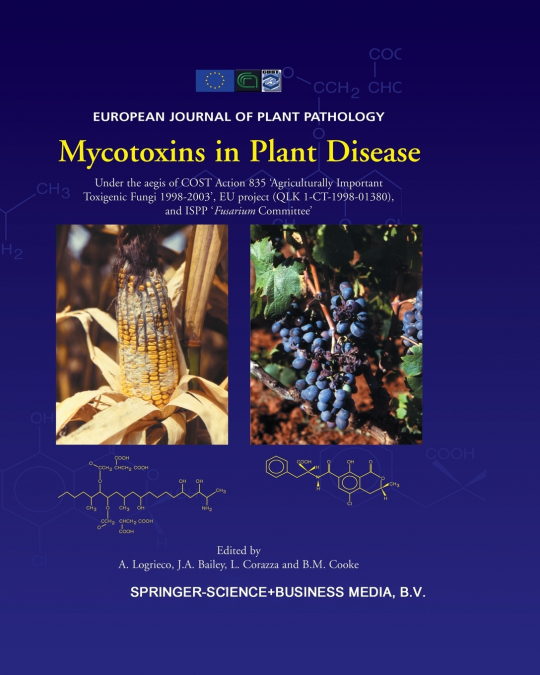

Mycotoxins in Plant Disease

Mycotoxins in Plant Disease


135,20 €
IVA incluido
Disponible
Editorial:
Springer Nature B.V.
Año de edición:
2014
Materia
Agronomía y producción agrícola
ISBN:
9789401039390
135,20 €
IVA incluido
Disponible

Selecciona una librería:

  • Librería Samer Atenea
  • Librería Aciertas (Toledo)
  • Kálamo Books
  • Librería Perelló (Valencia)
  • Librería Elías (Asturias)
  • Donde los libros
  • Librería Kolima (Madrid)
  • Librería Proteo (Málaga)

There is an urgent need to expand our knowledge of both the nature of the toxigenic fungi that are widespread on economically-important plants and the effect of their toxic secondary metabolites on human health. Informa­ tion about the production of mycotoxins by plant pathogens, particularly by species of Fusarium, Aspergillus and Penicillium, their occurrence in infected plants, as well as their role in the plant-pathogen interaction, for example as virulence/pathogenicity factors, is a pre-requisite for preventing plant disease and hence for reducing the Ievels of mycotoxin contamination. Fusarium infections in cereals and other crops are a particular problern world-wide and recent epidemics on wheat in Europe, the USA and Canada have again focused attention on this problem. Fur­ thermore, species ofAspergillus and Penicillium and their related mycotoxins, particularly Ochratoxin A, represent another consistent problern on cereals and grapes, especially in Europe where 40% of the global grape crop is grown. The aim of this publication is to gather together specialist updated reviews based on papers originally presented during a Workshop of EU Cost Action 835 entitled ’Agriculturally Important Taxigenie Fungi’, held in Rome, 7-8 October 1999 at the Plant Pathology Research Institute. We hope the diversity of the contents will stimulate discussion, encourage the sharing of information and result in cross-fertilization of ideas needed for the solution of the present problems. This special issue will be of particular value to interdisciplinary scientists and especially mycologists, mycotoxicologists, plant pathologists and those concerned about the quality of food and food products.
Artículos relacionados

  • Recherches sur les instruments aratoires et le travail du sol en Gaule Belgique
    André Marbach
    A volume of detailed research and summary into metal farming tools used in Gaul/Upper Germania from the Gallo-Romano period; indeed many of the types are still in use today. 199 finds are investigated and reconstructed to show the various techniques of manufacture, use and efficiency. The new method of analysis has shown that ploughing equipment was capable of turning the soil ...
    Disponible

    109,47 €

  • Instant Insights
    Bryan G Hopkins / Dan S Long / Dr Dan S. Long / Dr Paul Miller / Prof Bryan G. Hopkins
    This book provides a detailed overview of the history, current status and future needs of fertiliser developments in an era where sustainability is of paramount importance. Chapters also review recent advances in the use of fertiliser technologies, such as crop sprayers. ...
    Disponible

    69,64 €

  • Instant Insights
    Dr Roland Pieruschka / Dr Sherif Hamdy / Prof Ulrich Schurr / Thomas Vatter
    This book reviews recent advances in the application of phenotyping techniques to optimise crop breeding programmes. Chapters discuss the use of phenotyping as a means of improving crop yield, boosting genetic gain and identifying desirable traits in crop roots. ...
    Disponible

    69,69 €

  • FOOD SECURITY ISSUES IN ASIA
    Paul Teng / TENG PAUL
    Asia is not only the largest producer of important food items like rice and vegetable oil, but also the largest importer of commodities like soybeans and corn. Additionally, more than half the world’s population lives in Asia and thus the largest number of food insecure people are also in Asia. Food security is therefore a matter of paramount importance in Asia.This is the only...
  • Developing circular agricultural production systems
    Barbara Amon
    This collection summarises the wealth of research on the ways of achieving circular agricultural production systems through using minimal inputs, closing nutrient loops, reducing emissions and reusing and valorising agricultural wastes. ...
  • Improving nitrogen use efficiency in crop production
    Professor Cl Wagner-Riddle
    This collection reviews the wealth of research on ways of improving nitrogen use efficiency in crop production as a means of reducing the agricultural sector’s environmental impact and rebalancing the global nitrogen cycle. ...