 Librería Samer Atenea
 Kálamo Books
 Librería Elías (Asturias)
 Librería Kolima (Madrid)
 Librería Proteo (Málaga)
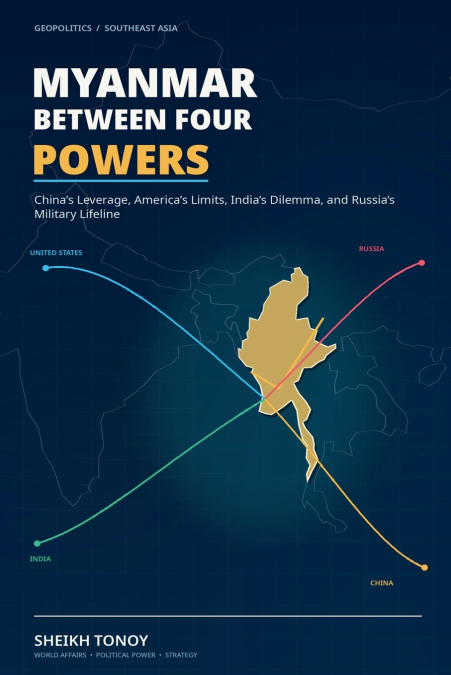
Who actually has leverage in Myanmar and what can each outside power reliably do with it?China has geography, border trade, infrastructure, energy links, and access to armed networks. Russia provides a narrower but strategically important military lifeline. India must balance border security, connectivity, competition with China, and instability on its northeastern frontier. The United States can impose financial and diplomatic costs and shape international legitimacy, yet it has limited direct access to territory and armed actors.MYANMAR BETWEEN FOUR POWERS rejects the easy image of a passive country trapped on a great-power chessboard. Sheikh Tonoy compares China, the United States, India, and Russia across geography, economics, military ties, political networks, diplomacy, and legitimacy while keeping Myanmar’s own actors at the center of the analysis.The book explains why China has the broadest structural leverage without having total control; why Russia’s narrower role can still matter disproportionately to military survival; why India’s exposure creates both access and constraint; and why American financial and diplomatic power does not translate easily into local command. It also examines how the military, ethnic armed organizations, the NUG, and resistance actors bargain with, resist, and exploit outside support, and how Rakhine, the Rohingya crisis, Bangladesh, ASEAN, and the United Nations reshape the regional consequences.This is a mechanism-based account of influence: not who 'owns' Myanmar, but who can change costs, options, and outcomes and where that leverage stops.