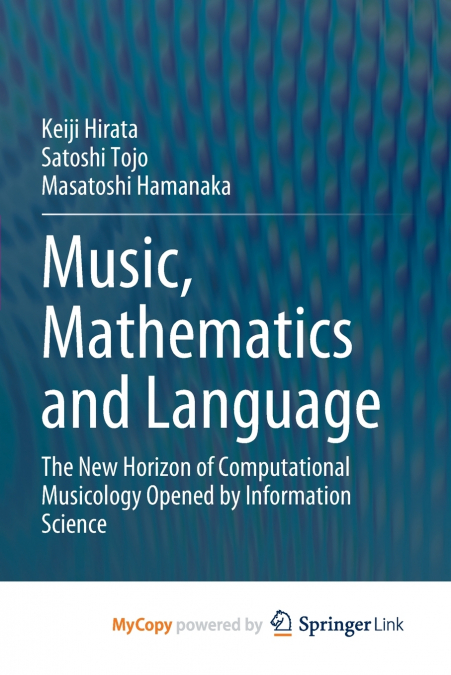
Music, Mathematics and Language

Music, Mathematics and Language

Keiji Hirata / Masatoshi Hamanaka / Satoshi Tojo

47,92 €
IVA incluido
Disponible
Editorial:
Springer Nature B.V.
Año de edición:
2022
Materia
Inteligencia artificial
ISBN:
9789811951671
47,92 €
IVA incluido
Disponible

Selecciona una librería:

  • Librería Samer Atenea
  • Librería Aciertas (Toledo)
  • Kálamo Books
  • Librería Perelló (Valencia)
  • Librería Elías (Asturias)
  • Donde los libros
  • Librería Kolima (Madrid)
  • Librería Proteo (Málaga)

This book presents a new approach to computational musicology in which music becomes a computational entity based on human cognition, allowing us to calculate music like numbers. Does music have semantics? Can the meaning of music be revealed using symbols and described using language? The authors seek to answer these questions in order to reveal the essence of music. Chapter 1 addresses a very fundamental point, the meaning of music, while referring to semiotics, gestalt, Schenkerian analysis and cognitive reality. Chapter 2 considers why the 12-tone equal temperament came to be prevalent. This chapter serves as an introduction to the mathematical definition of harmony, which concerns the ratios of frequency in tonic waves. Chapter 3, 'Music and Language,' explains the fundamentals of grammar theory and the compositionality principle, which states that the semantics of a sentence can be composed in parallel to its syntactic structure. In turn, Chapter 4 explains the most prevalent score notation - the Berklee method, which originated at the Berklee School of Music in Boston - from a different point of view, namely, symbolic computation based on music theory. Chapters 5 and 6 introduce readers to two important theories, the implication-realization model and generative theory of tonal music (GTTM), and explain the essence of these theories, also from a computational standpoint. The authors seek to reinterpret these theories, aiming at their formalization and implementation on a computer. Chapter 7 presents the outcomes of this attempt, describing the framework that the authors have developed, in which music is formalized and becomes computable. Chapters 8 and 9 are devoted to GTTM analyzers and the applications of GTTM. Lastly, Chapter 10 discusses the future of music in connection with computation and artificial intelligence.This book is intended both for general readers who are interested in music, and scientists whose research focuses onmusic information processing. In order to make the content as accessible as possible, each chapter is self-contained.
Artículos relacionados

  • Artificial Cognition Systems
    ...
  • Cross-Disciplinary Applications of Artificial Intelligence and Pattern Recognition
    Vijay Kumar Mago
    The need for intelligent machines in areas such as medical diagnostics, biometric security systems, and image processing motivates researchers to develop and explore new techniques, algorithms, and applications in this evolving field. Cross-Disciplinary Applications of Artificial Intelligence and Pattern Recognition: Advancing Technologies provides a common platform for researc...
  • Emerging Applications of Natural Language Processing
    Over the last few years, the area of Natural Language Processing has drastically grown in recognition, not only within the research and development community, but also with industry professionals. As NLP continues to be discussed and researched, certain areas continue to grow and mature. As a result, the need for advanced research and information is in high demand. Emerging App...
  • Androids, Cyborgs, and Robots in Contemporary Culture and Society
    Steven John Thompson
    Mankind’s dependence on artificial intelligence and robotics is increasing rapidly as technology becomes more advanced. Finding a way to seamlessly intertwine these two worlds will help boost productivity in society and aid in a variety of ways in modern civilization. Androids, Cyborgs, and Robots in Contemporary Culture and Society is an essential scholarly resource that delve...
  • Deep Learning Innovations and Their Convergence With Big Data
    The expansion of digital data has transformed various sectors of business such as healthcare, industrial manufacturing, and transportation. A new way of solving business problems has emerged through the use of machine learning techniques in conjunction with big data analytics. Deep Learning Innovations and Their Convergence With Big Data is a pivotal reference for the latest sc...
  • Computational Psychoanalysis and Formal Bi-Logic Frameworks
    Giuseppe Iurato
    Computational psychoanalysis is a new field stemming from Freudian psychoanalysis. The new area aims to understand the primary formal structures and running mechanisms of the unconscious while implementing them into computer sciences. Computational Psychoanalysis and Formal Bi-Logic Frameworks provides emerging information on this new field which uses psychoanalysis and the unc...